
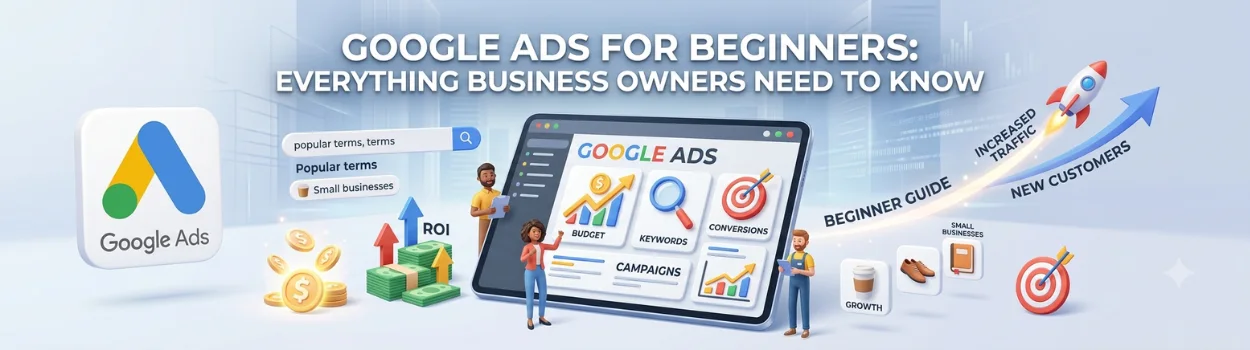
For many business owners, getting discovered online is no longer the biggest challenge. The real challenge is getting discovered by the right people at the right moment. You may have a professional website, active social media accounts, and valuable products or services, but none of these automatically guarantee a consistent flow of enquiries or sales.
This is where Google Ads can play an important role. Instead of waiting months for organic visibility to improve, businesses can use paid advertising to appear when potential customers actively search for relevant products or services. Someone searching for “digital marketing agency near me,” “commercial electrician in Pune,” or “best accounting software for small business” is already showing intent. Google Ads gives businesses an opportunity to reach that person while the need is active.
However, advertising on Google is not simply about creating an ad and adding money to an account. Successful campaigns require keyword research, targeting, compelling ad copy, effective landing pages, conversion tracking, and continuous optimization.
This Google Ads for Beginners guide explains how Google Ads works, what business owners should understand before investing, how costs are calculated, and how a performance marketing approach can turn advertising spend into measurable business growth.
What Is Google Ads?
Google Ads is Google’s online advertising platform that allows businesses to promote their products and services across Google Search and other Google-owned or partner properties. For beginners, the easiest way to understand the platform is to think of it as a system that helps businesses pay for additional visibility in places where their potential customers are searching, browsing, watching videos, or researching products.
Search advertising is one of the most familiar examples. When someone searches Google for a service, sponsored results can appear above or alongside organic search results. Businesses compete for these placements based on several factors rather than simply paying for guaranteed rankings.
The platform can support businesses at different stages of the customer journey. Search campaigns can capture existing demand, while Display, YouTube, Demand Gen, Shopping, and other campaign formats can help businesses build awareness, reconnect with previous visitors, or encourage purchases.
For a business owner exploring Google Ads for Beginners, the important thing to understand is that the platform is highly measurable. Advertisers can track what happens after someone interacts with an advertisement and use that information to improve future campaigns.
Google Ads can help businesses:
- Generate qualified enquiries and leads.
- Drive relevant visitors to a website or landing page.
- Increase online or offline sales opportunities.
- Promote products to people actively researching them.
- Measure advertising performance through conversions and other business metrics.

How Does Google Ads Work?
Google Ads operates using an automated auction system. When someone performs a relevant Google search, an auction can take place almost instantly to determine which eligible advertisements appear and where they are positioned.
A common misconception among beginners is that the advertiser willing to pay the highest amount automatically receives the best position. Bids matter, but Google also evaluates other signals related to relevance, expected performance, user experience, and the context of the search.
This creates an important opportunity for smaller businesses. A company with a carefully structured campaign, relevant advertisement, useful landing page, and appropriate bidding strategy may compete effectively even when larger competitors have bigger advertising budgets.
For example, imagine a local business providing website development services. Instead of broadly advertising to everyone interested in technology, it could target searches showing commercial intent. The advertisement can then direct users to a dedicated page explaining the service, showing proof of work, and providing a clear enquiry option.
The basic process looks like this:
- A potential customer searches for something on Google.
- Google identifies advertisements eligible for that search.
- An automated auction evaluates bids, relevance, quality, and other signals.
- Selected advertisements appear in available sponsored positions.
- Advertisers measure clicks, leads, calls, purchases, or other desired actions.
Understanding Google Ads Campaign Types
Choosing the right campaign type is one of the first major decisions when starting with Google Ads. Different campaign formats serve different purposes, so businesses should select campaigns based on their goals rather than simply choosing the format that appears easiest to create.
Search campaigns are particularly useful when customers already know what they need. Someone searching “office interior designer near me” or “SEO services for small business” demonstrates much stronger commercial intent than someone casually browsing unrelated content.
Other campaign types can support awareness, product discovery, remarketing, and broader customer acquisition. Businesses often use several campaign types together once enough conversion data and budget are available.
Search Campaigns
Search campaigns display text-based advertisements around relevant searches. They are commonly used by service businesses, B2B companies, local businesses, and businesses focused on lead generation.
They work particularly well when customers actively search for the solution being advertised.
Display Campaigns
Display campaigns can show visual advertisements across websites, apps, and other placements within Google’s advertising ecosystem. They are often used for awareness and remarketing strategies.
Display advertising can help businesses remain visible to audiences beyond the search results.
Shopping Campaigns
Shopping-focused advertising is designed primarily for e-commerce businesses. Product advertisements can display useful information such as product imagery, names, stores, and prices.
This gives potential buyers valuable information before they visit the website.
Video Campaigns
Video advertising allows businesses to reach audiences through YouTube and eligible video inventory. Video can be particularly useful when a product requires explanation, demonstration, storytelling, or stronger brand recognition.
Performance Max
Performance Max allows advertisers to access multiple Google advertising channels through one goal-based campaign. Google’s automation can use assets, audience signals, conversion data, and machine learning to determine where and how advertisements should appear
How Much Does Google Ads Cost?
One of the most common questions in any Google Ads for Beginners discussion is: “How much should I spend?”
There is no universal Google Ads price. Advertising costs vary significantly depending on the industry, location, competition, keywords, campaign goals, targeting, bidding strategy, and quality of the overall campaign.
A local service business operating within a limited geographic area may have very different costs from a national financial services company competing for highly valuable commercial keywords.
Instead of asking only, “How much does a click cost?” business owners should think about the economics behind acquiring a customer. A ₹200 click might appear expensive, but if those clicks consistently generate profitable customers worth thousands of rupees, the advertising can still make financial sense.
Important cost factors include:
- Competition for your target searches.
- Geographic targeting and market size.
- Industry and customer value.
- Keyword intent and relevance.
- Landing-page and campaign performance.
The goal should not always be to achieve the cheapest click. The goal is to generate valuable business outcomes at an acceptable acquisition cost.
Keywords: The Foundation of Search Advertising
Keywords help connect Search ads with the searches potential customers perform. Choosing the right keywords is therefore one of the most important parts of building a successful Search campaign.
Beginners often make the mistake of targeting broad, high-volume terms because they appear to offer greater visibility. But more traffic does not automatically mean more customers. A smaller number of visitors with strong commercial intent can be considerably more valuable.
Suppose a business provides corporate photography. A broad keyword around “photography” could attract students, hobbyists, people searching for images, or users looking for photography courses. A more specific search related to “corporate photographer for office event” is much closer to a potential customer.
Effective keyword strategies consider:
- Search intent behind the keyword.
- Relevance to the actual service or product.
- Commercial value of the search.
- Geographic relevance.
- Negative keywords that prevent irrelevant traffic.
What Are Negative Keywords?
Negative keywords help prevent advertisements from appearing for searches that are not relevant to your business. They can be one of the simplest ways to reduce wasted advertising spend.
For example, a company selling premium business consulting services may not want its advertisements appearing for searches involving “free consulting course,” “consulting jobs,” or “consulting salary.” Those users are looking for something different from the service being advertised.
Regularly reviewing search-term data helps advertisers identify irrelevant queries and expand their negative keyword lists.
Negative keywords can help:
- Reduce irrelevant clicks.
- Protect advertising budget.
- Improve traffic quality.
- Increase campaign relevance.
- Focus spending on searches more likely to convert.
Why Your Landing Page Matters as Much as Your Ad
Getting someone to click your advertisement is only the beginning. The website or landing page must convince that visitor to take the next step.
A common Google Ads mistake is sending every visitor to the website homepage. A homepage may contain information about many products, services, and company details, which can create unnecessary friction for someone looking for one specific solution.
A dedicated landing page creates continuity between the user’s search, the advertisement, and the offer. If someone searches for an SEO service, clicks an advertisement about SEO, and reaches a page specifically explaining that service, the experience feels relevant.
Effective landing pages usually provide:
- A clear headline matching the visitor’s intent.
- Concise explanation of the offer and benefits.
- Trust signals such as testimonials, reviews, certifications, or case studies.
- A visible and compelling call to action.
- Fast loading and a strong mobile experience.
More advertising spend cannot compensate indefinitely for a weak landing page. Improving conversion rate is often one of the most effective ways to improve advertising economics.
Important Google Ads Metrics Business Owners Should Know
Google Ads contains a large amount of data, and beginners can easily become distracted by dozens of metrics. Business owners do not need to become advertising analysts, but understanding a few core metrics makes campaign discussions much easier.
Click-through rate (CTR) shows how often people click an advertisement after seeing it. Cost per click (CPC) shows the average amount paid for clicks. Conversion rate measures how frequently visitors complete the desired action.
Cost per acquisition or cost per conversion is often more commercially useful because it connects advertising spend with actual results. For e-commerce campaigns, return on ad spend (ROAS) can help show how much tracked revenue is generated relative to advertising spend.
Important metrics include:
Impressions: How often advertisements were shown.
CTR: Percentage of impressions resulting in clicks.
CPC: Average cost paid for a click.
Conversion rate: Percentage of visitors completing a desired action.
CPA/ROAS: Measures connecting advertising costs with conversions or revenue.
Google Ads and Performance Marketing
Google Ads becomes particularly powerful when approached as part of a performance marketing strategy.
Performance marketing focuses on measurable outcomes instead of simply buying visibility. Rather than judging success by impressions or clicks alone, businesses evaluate whether campaigns generate qualified leads, customers, sales, revenue, or another commercially valuable result.
This changes how advertising decisions are made. Keywords can be evaluated according to conversion performance. Landing pages can be tested. Budgets can be shifted toward profitable campaigns. Poor-performing searches can be excluded, and successful campaigns can be expanded.
A performance marketing approach typically involves:
- Setting measurable campaign objectives.
- Tracking meaningful conversions accurately.
- Evaluating cost per lead or customer.
- Testing advertisements and landing pages.
- Continuously reallocating budget based on results.
The goal is not simply to “run Google Ads.” The goal is to build an advertising system where decisions are driven by measurable business performance.
Common Google Ads Mistakes Beginners Should Avoid
Google Ads is relatively easy to start but much harder to manage efficiently. Many businesses lose money not because paid advertising does not work, but because campaigns are launched without sufficient planning, tracking, or optimization.
One common mistake is using overly broad targeting. Another is focusing heavily on clicks without investigating whether those visitors become genuine prospects. Poor conversion tracking can make this problem worse because the business cannot clearly identify what is working.
Campaigns also require ongoing management. Search behavior changes, competitors adjust strategies, new search terms appear, and performance can fluctuate over time. A campaign that performed well several months ago should not automatically be assumed to remain optimized.
Common beginner mistakes include:
- Targeting keywords without understanding search intent.
- Sending every visitor to the homepage.
- Ignoring negative keywords and search terms.
- Running campaigns without reliable conversion tracking.
- Making major decisions before collecting enough meaningful data.
Google Ads vs SEO: Which Is Better?
Google Ads and SEO are sometimes presented as competing strategies, but businesses often achieve better results when they understand the different role each channel plays.
Google Ads can provide visibility quickly. Once campaigns are approved and active, businesses can begin reaching relevant searches without waiting for organic rankings to develop. This makes paid search useful for promotions, new services, lead generation, market testing, and competitive search categories.
SEO generally requires more time but can create compounding organic visibility. Helpful pages, authoritative content, technical optimization, backlinks, and stronger brand authority can continue attracting visitors without paying for every individual click.
For many businesses, the strongest approach combines both. Google Ads can capture immediate demand while SEO builds sustainable organic visibility.
In simple terms:
- Google Ads can generate visibility quickly.
- SEO focuses on long-term organic growth.
- Paid campaigns provide useful keyword and conversion insights.
- SEO content can support broader brand authority.
- Combining both reduces dependence on a single acquisition channel.
Should Small Businesses Use Google Ads?
Google Ads can work extremely well for small businesses when there is genuine search demand and the campaign economics make sense.
Local businesses can target specific geographic areas instead of advertising nationally. Service businesses can focus on high-intent searches. B2B companies can promote specialized solutions. E-commerce brands can advertise products directly to potential buyers.
The size of the budget matters less than how intelligently it is allocated. A focused campaign targeting commercially relevant searches can sometimes generate better results than a large campaign trying to reach everyone.
Google Ads may be particularly useful when your business:
- Provides a service people actively search for.
- Has a clear target market and geographic area.
- Can respond quickly to incoming enquiries.
- Has a strong website or landing page.
- Understands the approximate value of a lead or customer.
How Long Does It Take for Google Ads to Work?
Google Ads can start generating traffic soon after a campaign becomes eligible to serve, but profitable optimization usually takes longer.
Early campaign data helps reveal which keywords attract the right users, which advertisements generate engagement, which devices or locations perform better, and which searches produce meaningful conversions.
Businesses should avoid expecting every campaign to achieve its optimal performance immediately. Advertising often involves a cycle of data collection, analysis, testing, and refinement.
A healthy optimization process involves:
- Collecting enough meaningful campaign data.
- Reviewing actual search terms.
- Evaluating conversion quality.
- Testing advertisements and landing pages.
- Adjusting bids, budgets, targeting, and exclusions based on results.
Patience does not mean leaving campaigns untouched. It means making informed decisions rather than reacting to every short-term fluctuation.
Do You Need a Professional Google Ads Agency?
Some businesses successfully manage smaller campaigns internally. However, as advertising budgets, services, locations, products, and conversion paths become more complex, professional management can become valuable.
An experienced digital marketing agency does more than create advertisements. Effective campaign management should connect advertising strategy with keyword research, analytics, landing-page optimization, conversion tracking, and overall performance marketing goals.
Professional management can also save business owners time. Instead of regularly analyzing search terms, bidding strategies, campaign structure, tracking issues, and landing-page performance, owners can focus on operations while specialists manage customer acquisition.
A professional Google Ads partner should help with:
- Campaign and keyword strategy.
- Conversion tracking and analytics.
- Ad copy development and testing.
- Landing-page recommendations.
- Continuous optimization and performance reporting.
The agency should also be able to explain where the advertising budget is going and what business results it is producing.
Final Thoughts
For business owners learning Google Ads for Beginners, the most important lesson is simple: Google Ads is not a shortcut where money automatically produces customers.
It is a measurable customer acquisition platform. Results depend on understanding customer intent, choosing the right campaign structure, targeting relevant searches, creating persuasive advertisements, providing strong landing-page experiences, tracking meaningful conversions, and continuously improving performance.
Businesses that approach Google Ads through a performance marketing mindset can make smarter decisions because they focus on outcomes rather than vanity metrics. Instead of asking only how many clicks an advertisement generated, they ask how many qualified enquiries, sales, or customers those clicks produced.
When Google Ads, SEO, landing-page optimization, analytics, and conversion strategy work together, paid advertising becomes much more than a traffic source. It becomes part of a predictable digital growth system.
If your business is considering Google Ads but you are unsure where to start, professional campaign planning and management can help reduce wasted spend and create a clearer path toward measurable results.
Looking for professional Google Ads and performance marketing services?
Niranjan Enterprises helps small businesses, startups, and growing companies build data-driven digital marketing campaigns focused on generating relevant traffic, qualified leads, and measurable business growth.
Whether you are launching Google Ads for the first time or want to improve an existing campaign, the right strategy starts with understanding your customers, your numbers, and the actions that generate real business value.
Ready to turn Google searches into business opportunities? Contact Niranjan Enterprises to discuss your Google Ads strategy.