
Digital marketing has become essential for almost every business, whether you run a local service company, an e-commerce store, a startup, or a growing B2B company. Businesses use Google, social media, websites, email, content, and paid advertising to attract customers and build their online presence. However, not every digital marketing activity is directly connected to measurable business results.
This is where performance marketing comes in. Instead of focusing mainly on visibility, followers, impressions, or traffic, performance marketing places measurable outcomes such as leads, sales, bookings, app installs, and revenue at the center of the strategy.
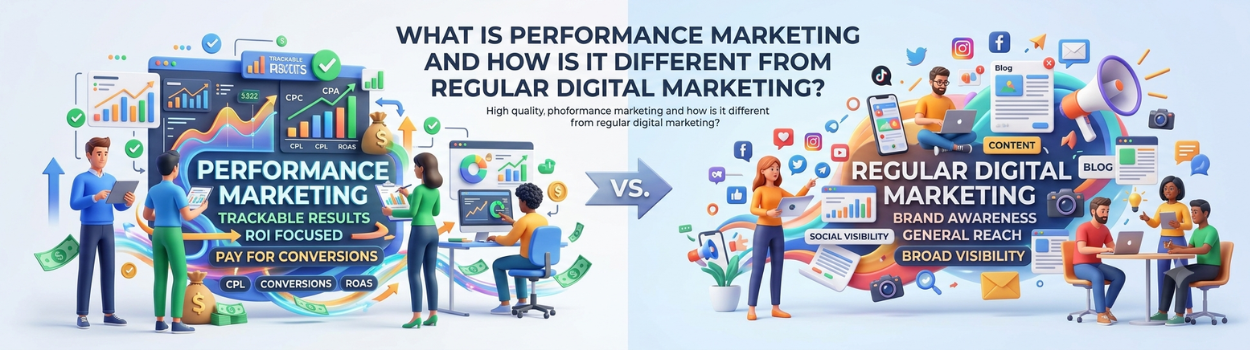
So, what is performance marketing vs digital marketing, and which approach should your business use? The simplest explanation is that digital marketing is the broader category of promoting a business through digital channels, while performance marketing is a results-driven approach within digital marketing where campaigns are continuously measured and optimized around specific actions.
Understanding this difference can help business owners spend their marketing budget more effectively and choose strategies that support both immediate growth and long-term brand development.
What Is Digital Marketing?
Digital marketing refers to all marketing activities that use digital channels to reach, engage, influence, and convert potential customers. It covers a wide range of strategies, from building organic Google visibility through SEO to running paid campaigns on search engines and social platforms.
A business might use digital marketing to increase brand awareness, educate potential customers, generate website traffic, build an online community, collect leads, or drive sales. Because these objectives vary considerably, not every digital marketing activity needs to produce an immediate conversion.
For example, an SEO article answering an important customer question might not generate a sale on the day it is published. However, it can rank on Google for months or years, attract qualified visitors, establish expertise, earn backlinks, and eventually contribute to leads and sales.
Similarly, consistent social media content can keep a business visible to potential customers before they are ready to buy. This makes digital marketing particularly valuable for building long-term digital assets and customer relationships.
Common digital marketing activities include:
- Search Engine Optimization (SEO)
- Social media marketing
- Content marketing and blogging
- Email marketing and automation
- Google Ads and paid search
- Social media advertising
- Video marketing
- Website and landing page optimization
- Online reputation and local search marketing
Digital marketing therefore describes the overall ecosystem. Performance marketing is one specialized approach operating within that ecosystem.

What Is Performance Marketing?
Performance marketing is a data-driven form of digital marketing in which campaigns are planned, measured, and optimized around clearly defined business outcomes.
Instead of simply asking, “How many people saw our advertisement?”, performance marketers ask more commercially important questions: How many qualified leads did we generate? What did each lead cost? How many became customers? How much revenue did the campaign produce? Can we increase the budget without making customer acquisition too expensive?
Imagine a home service company spending ₹50,000 on advertising. A traditional campaign report might highlight impressions, reach, clicks, and engagement. A performance-focused report goes further by connecting that ₹50,000 investment with enquiries, qualified leads, appointments, customers, and revenue.
This emphasis on measurable outcomes is what makes performance marketing attractive to startups and small businesses. When budgets are limited, business owners need greater clarity about where their money is going and what it is producing.
Performance marketing campaigns commonly optimize for actions such as:
- Lead form submissions
- Phone calls and enquiries
- Product purchases
- Appointment bookings
- Demo requests
- App installations
- Trial or account registrations
- Qualified leads and customer acquisitions
The goal is not merely to advertise more. It is to create a measurable system that can continuously improve the relationship between marketing investment and business results.
What Is Performance Marketing vs Digital Marketing?
The biggest misunderstanding is treating performance marketing and digital marketing as two completely separate types of marketing.
They are not.
Digital marketing is the broader umbrella. Performance marketing is a specific results-focused methodology within it.
For example, publishing educational Instagram content is digital marketing. Running a Meta campaign optimized for qualified lead submissions is both digital marketing and performance marketing. Writing SEO content is digital marketing, while creating conversion-focused landing pages and tracking how organic visitors become customers introduces a stronger performance component.
Another important difference is the way success is evaluated. Regular digital marketing campaigns may measure awareness, reach, website visibility, audience growth, engagement, and traffic. Performance marketing typically prioritizes metrics closer to revenue, such as cost per lead, customer acquisition cost, conversion rate, and return on ad spend.
How Does Performance Marketing Work?
Performance marketing starts with a business objective rather than a marketing channel. Before deciding whether to use Google Ads, Meta Ads, LinkedIn Ads, remarketing, or another platform, the business needs to define what a successful outcome actually means.
For a real estate consultant, success could be qualified property enquiries. For an e-commerce company, it could be profitable purchases. For a B2B software company, it might be booked product demonstrations. For a local service provider, phone calls and appointments may matter most.
Once that objective is clear, marketers build a customer journey around it. They identify the target audience, choose suitable channels, develop offers and advertising creatives, create landing pages, configure conversion tracking, and launch campaigns.
The important part happens after launch. Performance campaigns are not meant to run unchanged for months. Marketers continuously analyze the data to understand which audiences, keywords, advertisements, offers, devices, locations, and landing pages produce the strongest results.
A typical process includes:
- Defining a measurable conversion goal
- Identifying high-intent target audiences
- Selecting appropriate advertising channels
- Creating ads and conversion-focused landing pages
- Implementing reliable conversion tracking
- Testing audiences, creatives, keywords, and offers
- Reducing spend on weak-performing segments
- Scaling campaigns that consistently produce profitable results
Performance marketing is therefore an ongoing optimization process rather than a one-time advertising activity.
Important Performance Marketing Metrics Businesses Should Understand
Good performance marketing depends on meaningful measurement. Having access to hundreds of metrics does not automatically lead to better decisions. Businesses need to identify which numbers are genuinely connected to growth.
Consider two campaigns. Campaign A generates 100 leads at ₹300 per lead. Campaign B generates 60 leads at ₹450 per lead. At first glance, Campaign A looks better.
But suppose only five leads from Campaign A become customers, while 15 leads from Campaign B convert. Campaign B could actually be significantly more valuable despite having a higher cost per lead.
That is why experienced performance marketers look beyond surface-level numbers and evaluate the complete customer journey.
Important metrics include:
- CPC (Cost Per Click): How much you pay, on average, for an advertising click.
- CPL (Cost Per Lead): The average advertising cost required to generate one lead.
- CPA (Cost Per Acquisition): The cost of generating a defined acquisition or customer action.
- Conversion Rate: The percentage of visitors or leads completing the desired action.
- ROAS (Return on Ad Spend): Revenue generated compared with advertising expenditure.
- CAC (Customer Acquisition Cost): The total cost required to acquire a new customer.
- LTV (Customer Lifetime Value): The estimated value a customer generates throughout their relationship with the business.
For most businesses, the most valuable metric is rarely the cheapest click. It is the ability to acquire profitable customers consistently.
Performance Marketing vs Traditional Paid Advertising
Another common misconception is that every paid advertisement automatically qualifies as performance marketing.
Paying for an advertisement only makes it paid media. Performance marketing requires deeper measurement and optimization around meaningful outcomes.
For example, a business could spend ₹1 lakh on social media advertising and receive millions of impressions. If it cannot determine how many qualified leads, sales, or customers were generated, the campaign has limited performance visibility.
A true performance marketing approach connects advertising activity to outcomes wherever reliable tracking is possible. This enables businesses to understand which campaigns deserve more investment and which ones need improvement.
The distinction typically comes down to:
- Clear conversion goals
- Accurate tracking
- Cost-per-result measurement
- Continuous experimentation
- Revenue or lead-quality analysis
This makes performance marketing particularly useful when businesses need greater accountability from their advertising budget.

Which Channels Are Used in Performance Marketing?
Performance marketing is not tied to one advertising platform. The best channel depends on customer intent, buying behavior, industry, offer, sales cycle, and budget.
Google Search Ads can work particularly well when customers are already searching for a service or product. Social advertising can help businesses reach potential customers based on demographics, interests, behaviors, or existing customer data. B2B businesses may use professional targeting to reach decision-makers within specific industries or job functions.
Remarketing can then reconnect with visitors who showed interest but did not convert during their first interaction.
Common performance channels include:
- Google Search and Shopping campaigns
- Meta advertising
- LinkedIn advertising
- YouTube advertising
- Display and remarketing campaigns
- Affiliate and partner marketing
- Marketplace advertising
- Conversion-focused email campaigns
The correct strategy is not to advertise everywhere. It is to identify where your highest-value customers can be reached efficiently.
Is Performance Marketing Better Than Digital Marketing?
Performance marketing is not automatically better than digital marketing because performance marketing is part of digital marketing.
A business focused exclusively on immediate conversions may miss opportunities to build brand awareness, organic visibility, trust, customer loyalty, and future demand. On the other hand, a business investing only in awareness and content without tracking leads or revenue may struggle to understand the commercial impact of its marketing.
Strong growth strategies therefore combine both approaches.
SEO and content can create long-term visibility. Social media can strengthen brand recognition and customer relationships. Email marketing can nurture prospects. Paid campaigns can capture immediate demand. Performance measurement can then help the business understand how these activities contribute to conversions and revenue.
A balanced strategy may include:
- SEO for sustainable organic visibility
- Content marketing for authority and trust
- Social media for audience engagement
- Email marketing for lead nurturing
- Performance campaigns for measurable acquisition
The ideal mix depends on your business model, market, budget, and growth stage.
Common Performance Marketing Mistakes
Performance marketing is highly measurable, but measurement alone does not guarantee good results.
One frequent mistake is optimizing exclusively for cheap leads. Low CPL can look impressive on a dashboard while producing poor sales results if those leads have little buying intent.
Another mistake is sending every advertising campaign to the website homepage. A visitor searching for a specific service should usually reach a page closely aligned with that need, not be expected to navigate through multiple pages to find the relevant information.
Businesses should watch for problems such as:
- Optimizing for lead quantity instead of lead quality
- Running campaigns without reliable conversion tracking
- Using weak or generic landing pages
- Scaling campaigns before enough data is available
- Ignoring the sales team’s feedback about leads
- Measuring advertising results without considering profit margins
- Making major campaign changes too frequently
Successful performance marketing requires advertising, analytics, conversion optimization, and sales feedback to work together.
Can Performance Marketing and SEO Work Together?
Yes. In fact, combining performance marketing with SEO can create a stronger growth strategy than treating them as competing channels.
Paid campaigns can generate immediate data about customer searches, offers, messages, and landing pages. SEO teams can use those insights to identify high-value topics and keywords worth targeting organically.
The relationship works in the opposite direction too. SEO content can attract potential customers early in their research process, while remarketing and paid campaigns can reconnect with those visitors later.
Together, SEO and performance marketing can help businesses:
- Capture both organic and paid search demand
- Learn which keywords generate valuable customers
- Reduce dependence on a single acquisition channel
- Build long-term traffic while pursuing short-term conversions
- Create a more complete customer journey
Businesses that coordinate these channels can use insights from one to improve the other.
Final Thoughts
If you are still wondering what is performance marketing vs digital marketing, remember one simple distinction: digital marketing describes the broader strategy of promoting and growing a business through digital channels, while performance marketing emphasizes measurable outcomes and continuous optimization.
Neither approach should exist in isolation.
Digital marketing helps businesses build visibility, authority, relationships, and long-term demand. Performance marketing adds greater accountability by connecting campaigns to leads, sales, customer acquisition, and revenue.
For small businesses and startups, the strongest approach is usually to combine long-term digital assets such as SEO, content, and brand development with carefully measured acquisition campaigns.
The objective should not simply be to generate more clicks.
It should be to build a marketing system that attracts the right audience, converts more prospects into customers, measures what actually contributes to growth, and improves as better data becomes available.
If your business is investing in digital marketing but still cannot clearly identify which activities generate qualified leads and customers, it may be time to introduce a stronger performance marketing strategy.
A professional digital marketing and performance marketing team can help you build the tracking, campaigns, landing pages, SEO strategy, and conversion systems needed to turn online visibility into measurable business growth.