
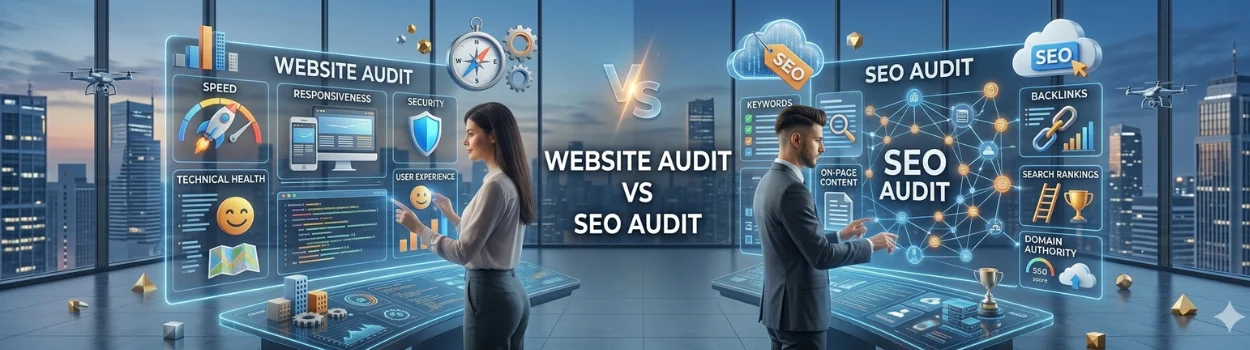
If your website isn’t generating leads, enquiries, or sales… you’re not alone.Most business owners invest in a website and expect results-but months later, there’s no traffic, no conversions, and no ROI.That’s when you hear terms like Website Audit vs SEO Audit.
But here’s the problem:
Most people don’t understand the difference, and end up fixing the wrong things.
Let’s simplify this-so you know exactly what your business needs to grow online.
Because clarity here directly impacts how you invest your time, money, and marketing efforts.
Making the right decision at this stage can save you months of trial and error.
The Real Problem: Why Your Website Isn’t Performing
- Your website looks “good” but doesn’t convert
- You’re getting traffic, but no enquiries
- Or worse-no traffic at all
- You’ve hired someone, but results are unclear
- A proper Website Audit, or
- A strategic SEO Audit

What is a Website Audit?
A Website Audit focuses on how your website performs for users.
Think of it as a full health check of your website experience.
It evaluates whether your website is actually helping visitors take action.
It also identifies friction points that silently kill conversions.
What a Website Audit Covers:
- Website design & layout (Is it professional?)
- User experience (Easy to navigate?)
- Mobile responsiveness
- Page speed & loading time
- Call-to-action (CTA) placement
- Content clarity (Does it explain your service clearly?)
- Conversion flow (Can visitors easily contact you?)
Goal of Website Audit:
Convert visitors into leads
Because traffic means nothing if your website doesn’t convert.
Even a small improvement in conversion rate can significantly increase your revenue.
That’s why this audit directly impacts your business growth.
What is an SEO Audit?
An SEO Audit focuses on how your website performs on search engines like Google.
This is where visibility comes in.
It ensures your website is discoverable by people actively searching for your services.
Without this, your ideal customers may never even find you.
What an SEO Audit Covers:
- Keyword optimization (Are you targeting the right keywords?)
- On-page SEO (titles, meta tags, headings)
- Technical SEO (indexing, crawl errors)
- Backlinks (authority of your website)
- Content optimization
- Competitor analysis
- Google ranking issues
Goal of SEO Audit:
Increase traffic from search engines
Because without SEO, your website is basically invisible online.
Higher rankings bring consistent, long-term traffic without ongoing ad spend.
This makes SEO one of the most cost-effective growth strategies.
Website Audit vs SEO Audit: Key Differences
| Factor | Website Audit | SEO Audit |
| Focus | User Experience | Search Engine Visibility |
| Goal | Improve conversions | Increase traffic |
| Works On | Design, UX, speed | Keywords, rankings, indexing |
| Outcome | More enquiries | More visitors |
- Website Audit = “Why visitors don’t convert”
- SEO Audit = “Why visitors don’t come”
Which One Do You Need?
This is where most business owners get confused.
You need a Website Audit if:
- You’re getting traffic but no leads
- Visitors leave your site quickly
- Your website feels outdated or confusing
Fixing these issues can instantly improve your lead generation.
It helps you maximize the value of the traffic you already have.
You need an SEO Audit if:
- You’re not ranking on Google
- You’re not getting organic traffic
- Competitors are outranking you
This helps you understand what’s stopping your visibility.
Once fixed, you can start attracting high-intent visitors consistently.
You need BOTH if:
- You want consistent growth + ROI
Because traffic + conversion = real business results
Focusing on both ensures you don’t miss opportunities at any stage.
This creates a complete and scalable growth system.
Real Insight: Why Most Businesses Fail Online
Here’s the harsh truth:
Most agencies focus only on SEO OR design.
But growth happens when you combine:
- Visibility (SEO)
- Experience (Website)
- Conversion (Strategy)
Without this combination:
You either get traffic with no leads
Or a beautiful website that nobody sees
This gap is where most businesses lose potential revenue.
A balanced approach is what separates average results from high-performing brands.
That’s why strategy matters more than just execution.
Practical Tips You Can Apply Today
Even before hiring an expert, start with this:
Quick Website Audit Checklist:
- Is your contact number visible?
- Is your CTA clear? (“Get Quote”, “Call Now”)
- Does your homepage explain what you do in 5 seconds?
- Is your website mobile-friendly?
These small changes can quickly improve user engagement.
They also make your website more action-driven and conversion-focused.
Quick SEO Audit Checklist:
- Are you using the right keywords?
- Do your pages have proper titles & descriptions?
- Are you ranking for your main services?
- Do you have enough content (blogs, pages)?
Consistency here builds long-term organic visibility.
Over time, this can reduce your dependency on paid marketing.
What Smart Businesses Do Differently
Smart business owners don’t guess.
They:
- Identify the real problem (traffic vs conversion)
- Fix the foundation first
- Invest in a data-driven audit
- Build a long-term growth strategy
They focus on sustainable growth instead of quick fixes.
They also track performance and continuously optimize their strategy.
This is what leads to predictable and scalable results.
Ready to Fix Your Website & Start Generating Leads?
If you’re serious about growing your business online, don’t rely on assumptions.
Start with a professional Website Audit + SEO Audit
Because once you know:
- What’s broken
- What’s missing
- What to fix first
Growth becomes predictable.
You get clarity on where to invest and what to improve.
This eliminates guesswork and speeds up your results.
It’s the smartest first step toward digital success.
Final Thoughts
Understanding Website Audit vs SEO Audit is the first step toward fixing your digital marketing.
- One brings people to your website
- The other converts them into customers
And you need both to scale.
When used together, they create a powerful growth engine.
They ensure your business is visible, effective, and competitive online.
That’s how you turn your website into a real asset.