
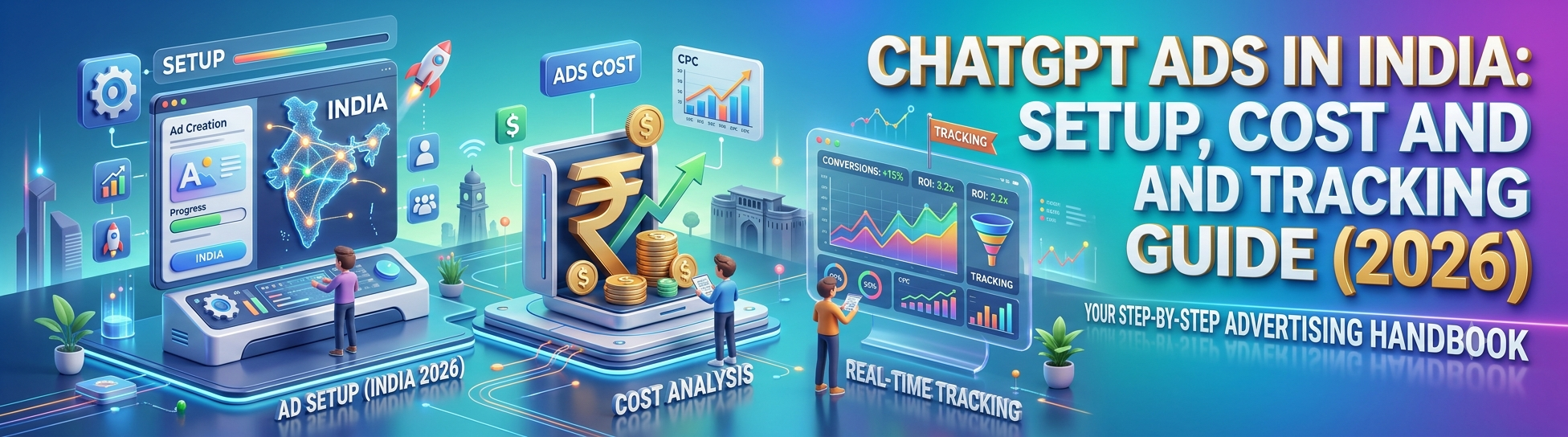
If your customers are increasingly using ChatGPT to research products, compare services, ask for recommendations, and make buying decisions, advertising on ChatGPT is becoming a new channel worth understanding. ChatGPT Ads in India are now available through OpenAI Ads Manager, giving businesses a way to reach potential customers inside an AI-powered decision-making environment.
Unlike traditional search advertising, where a user enters a short keyword such as “digital marketing agency Pune,” ChatGPT users often explain their situation in much greater detail. They may describe their business, budget, requirements, problems, and preferences in one conversation. OpenAI’s advertising system uses conversational context and other relevance signals to determine which ads may be useful.
For Indian startups, local businesses, ecommerce companies, SaaS brands, consultants, and service providers, this creates a different advertising opportunity. Instead of thinking only about keywords, marketers need to think about intent, context, customer problems, landing-page relevance, and conversion tracking.
- Availability: Self-service Ads Manager is currently available in India
- Minimum daily budget: ₹725 for campaigns billed in INR
- Tracking: Ads Manager reporting + conversion measurement + UTM parameters
What Are ChatGPT Ads?
ChatGPT Ads are paid advertisements displayed within the ChatGPT experience. OpenAI describes them as a way for businesses to reach people while they are exploring options, comparing alternatives, and making decisions. Ads are clearly identified and remain separate from ChatGPT’s answers.
This distinction is important for businesses considering the channel. An advertisement does not change the answer generated by ChatGPT. Instead, the ad is selected separately based on factors such as the context and intent of the conversation, the advertiser’s landing page, ad copy, and other signals. Advertisers can also provide context hints describing the types of conversations where their offering may be relevant.
For example, a business selling accounting software could create advertising around conversations involving bookkeeping, GST management, invoicing, business accounting, or finance software. The opportunity is therefore broader than traditional keyword targeting, although context hints should not be treated as exact-match keywords.
- Ads appear separately from ChatGPT responses.
- Ads include elements such as advertiser name, headline, description, landing page, and creative.
- Context and conversational intent are important delivery signals.
- Advertisers can provide context hints to describe relevant conversations.
- ChatGPT Ads are managed through OpenAI Ads Manager.
How to Advertise in ChatGPT From India
Indian businesses can currently access self-service ChatGPT advertising through OpenAI Ads Manager. OpenAI’s current availability documentation lists India as a country with self-service availability, meaning eligible businesses can create and manage campaigns directly rather than waiting for a partner-led campaign.
The basic setup starts with an OpenAI Ads Manager account. Businesses need to provide account information, add their brand details, configure billing, complete verification, and then create campaigns. OpenAI’s current quickstart documentation identifies account creation, billing/payment setup, verification, and campaign creation as core steps before launching.
For a small business, the most important preparation should happen before the campaign is launched. Decide exactly what you want ChatGPT users to do after clicking the ad. A vague goal such as “get more visibility” makes optimization difficult. A clearer goal could be generating qualified leads, receiving demo requests, driving ecommerce purchases, or generating website enquiries.
- Create or access your OpenAI Ads Manager account.
- Add your business and brand information.
- Set up the billing profile and payment method.
- Complete required account verification.
- Create your campaign, ad groups, ads, budget, and targeting settings.
ChatGPT Ads Cost in India: How Much Should You Budget?
There is no single fixed price for ChatGPT Ads in India. OpenAI currently supports different buying and optimization approaches, including CPM for impression-focused campaigns and CPC for click-focused campaigns. Conversion-focused campaigns may also use optimized CPC or optimized CPM depending on eligibility and configuration.
For campaigns using INR, OpenAI’s current documentation lists a minimum daily campaign budget of ₹725. This is a platform minimum, not a recommended budget for every business. Actual spending and results depend on your objective, bid, competition, relevance, audience/context, creative, and landing page.
OpenAI currently recommends starting with a maximum CPC bid of $3–$5 per click for CPC campaigns. However, this should not be interpreted as a guaranteed cost per click in India. It is bid guidance, while actual delivery and costs can vary based on the auction and campaign conditions.
For an Indian small business testing the channel, the sensible approach is to treat the first campaign as a controlled experiment. Start within the platform’s minimum requirements, establish baseline performance, identify which messages and contexts generate qualified traffic, and then increase spending based on measured business outcomes rather than impressions alone.
- Current minimum daily budget in INR: ₹725.
- CPC campaigns use maximum CPC bidding.
- OpenAI recommends a starting maximum CPC of $3–$5 for CPC campaigns.
- Actual CPC is not guaranteed and can vary.
- Budget should ultimately be evaluated against leads, sales, or other business conversions.
How to Set Up a ChatGPT Ads Campaign
Campaign structure matters because a business may have several products, services, or customer segments. Instead of putting everything into one advertisement, organize related offerings into focused ad groups. This makes it easier to develop different messages and understand which types of intent generate results.
Your ad copy should also be specific. OpenAI’s advertising guidance recommends clear, benefit-focused messaging rather than generic promotional language. Multiple distinct ad variations can give the system more opportunities to find relevant situations where your offer fits.
For example, a digital marketing agency could create separate messaging around SEO, Google Business Profile management, social media marketing, and performance advertising. Someone asking ChatGPT how to improve local search visibility may need a different message from someone looking for paid lead generation.
- Select a campaign objective aligned with the business outcome.
- Define relevant geographic targeting, including India or appropriate regions where available.
- Create focused ad groups around related offerings.
- Write multiple benefit-focused headline and description variations.
- Use a landing page that directly matches the promise made in the advertisement.
How to Track ChatGPT Ads and Measure ROI
Tracking is one of the most important parts of running ChatGPT Ads. Ads Manager currently provides reporting for metrics including impressions, clicks, spend, CTR, average CPC, average CPM, and conversions. This allows marketers to move beyond simply asking whether an advertisement received visibility.
You should also add UTM parameters to your landing-page URLs. OpenAI states that static tracking parameters can persist when someone clicks an ad, allowing businesses to analyze ChatGPT Ads traffic in their existing analytics platforms. This is particularly useful for businesses already using Google Analytics or another marketing analytics system.
Conversion tracking should be configured around meaningful business actions. For a service company, that might be a completed enquiry form, phone-call lead, consultation request, or appointment. For ecommerce, it may be a purchase. Measuring only clicks can make an apparently successful campaign look better than it actually is.
- Monitor impressions and CTR for initial engagement.
- Track CPC and total advertising spend.
- Use UTM parameters on ChatGPT Ads landing pages.
- Configure conversion measurement for meaningful business actions.
- Compare leads, sales, and revenue against advertising costs.
ChatGPT Ads vs Traditional Google Search Ads
ChatGPT Ads and Google Search Ads operate in different environments. Google Search advertising is fundamentally built around search queries, keywords, bidding, and search results. ChatGPT Ads are designed around an AI conversation where the system has access to richer contextual signals about what the user is trying to accomplish.
This does not mean businesses should automatically replace Google Ads with ChatGPT Ads. Instead, marketers should consider how the two channels can complement each other. Google can capture explicit search demand, while ChatGPT can provide another advertising touchpoint when users are researching, comparing, planning, or evaluating solutions.
The landing page remains critical in both cases. A strong advertisement cannot compensate for an unclear offer, slow website, weak proof, or difficult enquiry process.
- Google Ads is strongly associated with search-driven demand capture.
- ChatGPT Ads operate within conversational discovery and decision-making.
- Both channels require relevant advertising messages and landing pages.
- Conversion tracking is necessary to compare actual business outcomes.
- Businesses can test both channels rather than treating them as mutually exclusive.

Is ChatGPT Advertising Worth Testing for Small Businesses?
For a small business, the question should not simply be whether ChatGPT Ads are “good” or “bad.” The more useful question is whether your customers are likely to use AI conversations while researching the problem your business solves, and whether you can measure the resulting business value.
The opportunity is particularly interesting for businesses with clearly defined services, products, or solutions where customers spend time researching alternatives. A B2B software company, professional service provider, ecommerce brand, education business, or local service company could test different messages around specific customer needs.
OpenAI is also continuing to expand the advertising platform. In September 2026, OpenAI announced new AI-powered advertising experiences, including testing Sponsored Agents and integrations involving HubSpot and Shopify. These developments indicate that the advertising ecosystem is expanding beyond a conventional display-ad model toward more interactive AI-based experiences.
- Identify whether your audience researches solutions through AI tools.
- Start with a clearly measurable campaign objective.
- Build dedicated landing pages where appropriate.
- Track conversions rather than relying only on clicks.
- Scale only after establishing reliable performance data.
Final Takeaway: Building a ChatGPT Ads Strategy in India
ChatGPT Ads in India represent a new advertising opportunity for businesses that want to reach customers during AI-assisted research and decision-making. The platform is now available for self-service advertising in India, and businesses can manage campaigns through OpenAI Ads Manager.
The most important consideration is not simply launching an advertisement. Success will depend on how well your offer matches relevant customer intent, how clearly your creative communicates the benefit, how closely your landing page matches the ad, and how accurately you track conversions.
For Indian businesses, the practical starting point is to test ChatGPT Ads alongside existing channels such as Google Ads, SEO, social media, and content marketing. Use a controlled budget, establish tracking before launch, analyze the quality of leads or sales, and then make budget decisions based on measurable performance.
If your business is preparing for AI-powered search and discovery, OpenAI Ads should be considered as part of a broader AI-search marketing strategy—not as a replacement for SEO or traditional advertising.
- Platform: OpenAI Ads Manager
- India: Self-service advertising is currently available
- Minimum INR daily budget: ₹725
- Tracking: Ads Manager + UTM parameters + conversion measurement
- Strategy: Test → Measure → Optimize → Scale

