
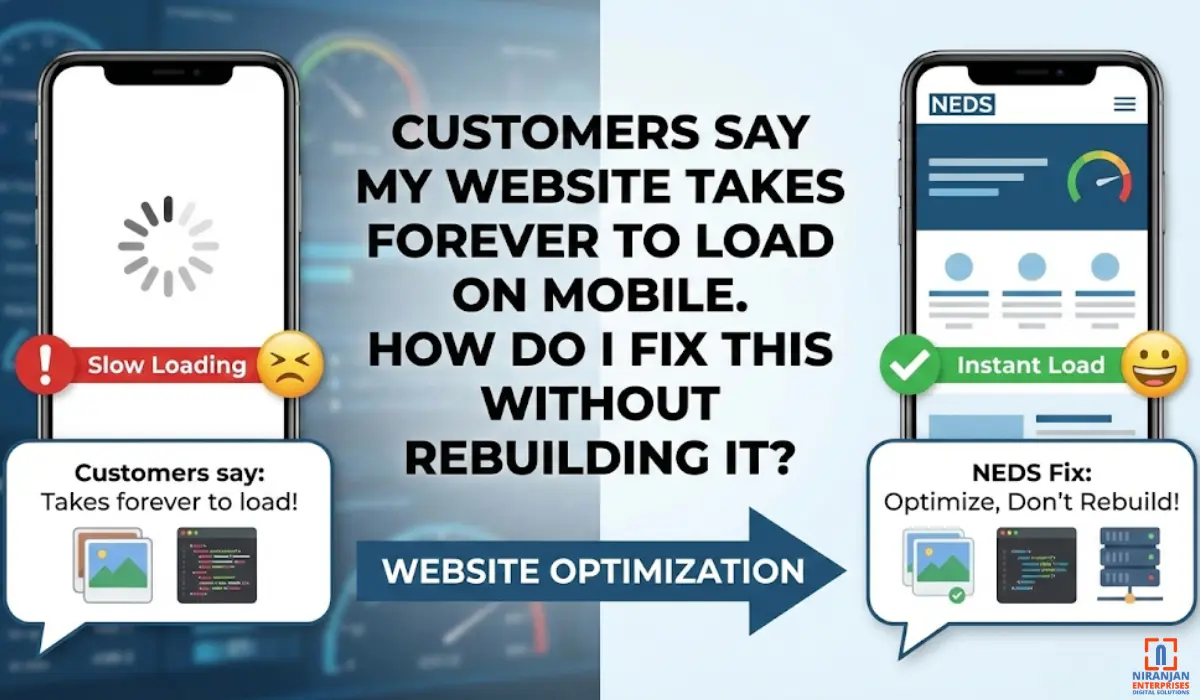
In the digital economy, speed is the ultimate currency. When a potential customer tells you, “I tried to visit your site on my phone, but it wouldn’t load, so I gave up,” they aren’t just complaining about technology. They are telling you that you just lost revenue.
For founders and marketing heads, this feedback often triggers panic. The immediate assumption is that the website is “broken” and needs a complete, expensive overhaul. You envision months of development, design meetings, and downtime.
At Niranjan Enterprises Digital Solutions (NEDS), we challenge this assumption. In 90% of cases, you do not need a new car; you just need to tune the engine.
A results-driven strategy focuses on website optimization–the art of refining your existing assets to perform at peak efficiency. Here is the strategic breakdown of why your mobile site is sluggish and how we fix it surgically, without the nightmare of a total rebuild.
1. The Heavyweight Champion: Unoptimized Images
The most common culprit for lagging website load time is visual content. High-resolution images that look stunning on a desktop monitor are often data-heavy monsters on a mobile device.
If you are loading a 5MB hero image on a 4G connection, you are forcing the user to wait.
The Surgical Fix: We implement “Next-Gen” image formatting. We convert your existing JPEGs and PNGs into WebP formats, which maintain high quality but reduce file size by up to 30-50%. We also implement “Lazy Loading,” ensuring that images only load as the user scrolls down to them, rather than all at once. This instantly improves your initial website page speed.
2. The Invisible Weight: Code Bloat
Over time, websites accumulate “digital dust.” Plugins you installed three years ago and deactivated (but didn’t delete), tracking scripts from old ad campaigns, and redundant CSS files all add up. This “bloat” forces the mobile browser to process thousands of lines of unnecessary code before it can show your content.
The Surgical Fix: We minify and defer. Website optimization involves stripping out the whitespace and comments from your code (minification) and telling the browser to prioritize visible content first (deferring JavaScript). This makes the site feel lighter and faster without changing a single pixel of the design.

3. The Distance Problem: Server Response Time
Sometimes, the problem isn’t the website; it’s where the website lives. If your server is slow to respond (Time to First Byte), everything else waits. If your customers are in Mumbai but your server is in New York, the physical distance creates latency.
The Surgical Fix: We utilize Content Delivery Networks (CDNs). A CDN stores copies of your website on servers around the world. When a customer in Pune visits your site, it loads from a Pune server, not one halfway across the globe. This drastically reduces website load time and improves reliability.
4. The Marketing Tax: Third-Party Scripts
As a marketing head, you love data. You have Google Analytics, the Facebook Pixel, LinkedIn Insights, and a Chatbot script running on your site. While valuable, these third-party scripts are notorious for slowing down mobile performance because they all fight for resources simultaneously.
The Surgical Fix: We don’t remove them; we manage them. By using Google Tag Manager effectively, we can control when these scripts fire. We ensure they load in the background after your customer sees the content, ensuring your analytics don’t cannibalize your user experience.
The Business Case for Speed
Why invest in website optimization instead of just leaving it alone?
Google Rankings: Google operates on a “Mobile-First Index.” If your mobile site is slow, your SEO rankings will drop, regardless of how good your content is.
Ad Costs: If you run Google Ads, a slow landing page lowers your Quality Score. This means you literally pay a higher Cost Per Click (CPC) than your faster competitors.
Conversion Rates: A one-second delay in mobile load times can impact conversion rates by up to 20%.

The NEDS Approach: Diagnosis Before Surgery
At Niranjan Enterprises Digital Solutions (NEDS), we don’t guess. We treat website optimization as a science. We start with a comprehensive audit to identify the specific bottlenecks choking your performance.
We believe that a fast website is the foundation of all digital growth. It improves your online visibility, lowers your customer acquisition costs, and most importantly, respects your customer’s time.
Do not tear down your website. Just wake it up. Stop losing mobile customers today. Run a Free Website Performance Check and let NEDS show you exactly what needs to be fixed.
Frequently Asked Questions (FAQs)
1. How fast should my website load on mobile?
The industry standard is under 3 seconds. However, for e-commerce and high-intent landing pages, aiming for under 2 seconds is ideal to maximize website page speed and conversions.
2. Will optimizing my website change how it looks?
No. Proper website optimization happens “under the hood.” We change how the files are delivered and processed, not the visual design or layout. Your site will look the same, just faster.
3. Is a slow mobile site hurting my Google ranking?
Yes, significantly. Google’s Core Web Vitals update explicitly made user experience (including speed) a ranking factor. A slow site is a direct penalty to your SEO visibility.
4. Can I fix website load time by just upgrading my hosting?
Sometimes, but not always. Better hosting improves server response time, but if your site has huge images and bad code, a faster server will just deliver the “mess” slightly faster. You need both hosting and optimization.
5. What is the difference between desktop and mobile speed?
Mobile devices have weaker processors and rely on cellular data (4G/5G), which is less stable than Wi-Fi. A site that loads instantly on a powerful office desktop might crawl on a mid-range smartphone.
6. Do plugins really slow down WordPress sites?
Yes. Every plugin adds code. If poorly coded, even a simple plugin can add seconds to your website load time. We recommend auditing plugins regularly and removing unused ones.
7. How often should I check my website performance?
We recommend a monthly check. As you add new blog posts, images, and products, your site can become heavy again. Continuous optimization is key to maintaining speed.
8. Can NEDS guarantee a 100/100 speed score?
We focus on real-world performance (Core Web Vitals) rather than vanity scores. While we aim for high scores, our priority is ensuring the site feels instant for the user and passes Google’s requirements for SEO.

