
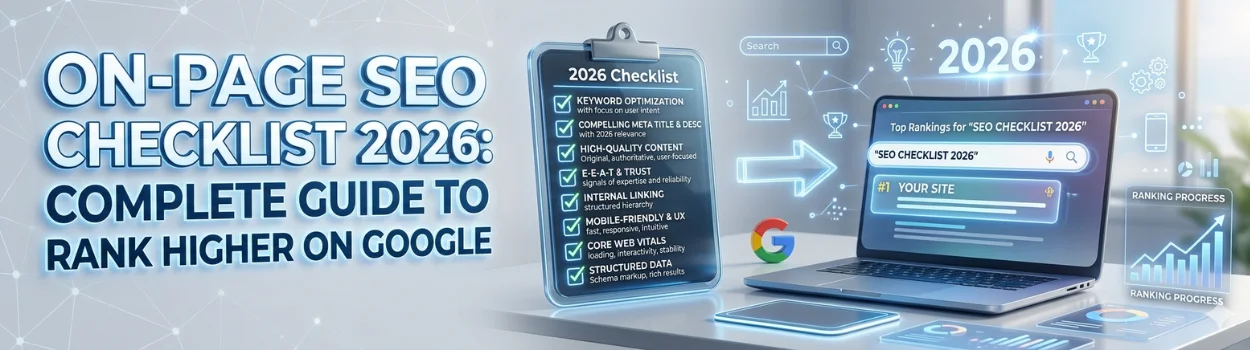
If your website is not ranking on Google even after publishing content regularly, the issue is often poor on-page SEO. In 2026, search engine optimization is no longer just about adding keywords. Google now focuses heavily on user intent, helpful content, AI-driven search experience, page speed, EEAT, and overall user engagement.
Businesses that ignore modern on-page SEO techniques are losing rankings, traffic, and leads to competitors who continuously optimize their websites.
This complete on-page SEO checklist 2026 will help you improve your website rankings, increase organic traffic, and build a stronger presence on Google.
What Is On-Page SEO?
On-page SEO refers to the process of optimizing individual web pages to improve rankings on search engines and attract relevant traffic.
It includes:
- Content optimization
- Keyword placement
- Meta tags
- Internal linking
- Image optimization
- User experience improvements
- Technical SEO elements
Unlike off-page SEO, which focuses on backlinks and external signals, on-page SEO gives you direct control over your website performance.
In 2026, Google’s algorithms are smarter than ever. Search engines now evaluate:
- Content quality
- User satisfaction
- Content relevance
- Website speed
- Mobile usability
- AI search compatibility
That is why businesses must follow updated SEO best practices 2026 to stay competitive.
Complete On-Page SEO Checklist 2026
Use One Primary Keyword Per Page
Every page should focus on one main keyword. For this blog, the primary keyword is:
on-page SEO checklist 2026
Avoid targeting too many unrelated keywords on a single page. This helps Google clearly understand your topic and improves ranking potential.
Place the keyword naturally in:
- Title
- URL
- Introduction
- Headings
- Meta description
- Conclusion
At the same time, avoid keyword stuffing because it negatively impacts readability and rankings.
Optimize SEO Title Tags
Your title tag is one of the most important ranking factors.
A good SEO title should:
- Include the target keyword
- Create curiosity
- Stay under 60 characters
- Encourage clicks
Example:
On-Page SEO Checklist 2026: 25 Proven Ways to Rank Higher
Using numbers and power words improves CTR significantly.
Write Compelling Meta Descriptions
Meta descriptions help improve click-through rates from search results.
A high-performing meta description should:
- Include the target keyword
- Highlight benefits
- Add a CTA
- Stay under 160 characters
Example:
“Follow this complete on-page SEO checklist 2026 to improve Google rankings, boost traffic, optimize content, and increase website performance.”
Use SEO-Friendly URLs
URLs should be short, clean, and descriptive.
Good URL:
yourwebsite.com/on-page-seo-checklist-2026
Bad URL:
yourwebsite.com/post?id=45678
SEO-friendly URLs improve user experience and search visibility.
Optimize Headings Properly
Your content should use a clear heading structure.
Use:
- One H1 tag
- Multiple H2 tags
- Relevant H3 subheadings
Headings improve:
- Readability
- User engagement
- SEO crawlability
Include related semantic keywords naturally in headings where relevant.
Match Search Intent
Search intent optimization is critical in 2026.
Before creating content, understand what users actually want.
For the keyword “on-page SEO checklist 2026,” users expect:
- Actionable tips
- Updated SEO strategies
- Step-by-step guidance
- Ranking improvements
If your content does not match search intent, rankings will drop even with strong keywords.
Improve Content Readability
Readable content performs better on Google.
To improve readability:
- Use short paragraphs
- Add bullet points
- Break long sections
- Use simple language
- Add visuals and examples
Modern users scan content quickly. Easy-to-read pages improve engagement and reduce bounce rates.
Add Internal Links Strategically
Internal linking helps search engines understand your website structure.
Benefits of internal linking:
- Improves page authority
- Increases time on site
- Helps indexing
- Reduces bounce rate
Link related blog posts, service pages, and resources naturally within your content.
A strong internal linking strategy is one of the most underrated SEO optimization tips.
Optimize Images for SEO
- Compressing images
- Using WebP format
- Adding descriptive ALT text
- Renaming image files properly
Improve Core Web Vitals
Core Web Vitals are major Google ranking factors in 2026.
Google measures:
- Loading speed
- Visual stability
- Interactivity
A slow website creates poor user experience and hurts rankings.
To improve page speed:
- Use fast hosting
- Minimize scripts
- Compress files
- Enable caching
- Use CDN services
Fast-loading websites generally rank better and convert more visitors.
Make Your Website Mobile-Friendly
- Load quickly
- Have responsive design
- Use readable fonts
- Avoid intrusive popups
- Provide easy navigation
Create EEAT-Focused Content
EEAT stands for:
- Experience
- Expertise
- Authoritativeness
- Trustworthiness
Google prioritizes trustworthy and helpful content.
To improve EEAT SEO:
- Add author bios
- Share real examples
- Use accurate information
- Add testimonials
- Include trust signals
Websites demonstrating expertise usually perform better in competitive niches.
Optimize for AI Search and SGE
Google’s AI-powered search experience is changing SEO rapidly.
To optimize for AI search:
- Answer questions directly
- Use conversational content
- Add FAQ sections
- Structure content clearly
- Build topical authority
AI search systems prefer content that provides clear and valuable answers quickly.
This makes helpful content optimization more important than ever.
Use Schema Markup
Schema markup helps search engines understand your content better.
Important schema types include:
- FAQ schema
- Article schema
- Breadcrumb schema
- Review schema
Schema can improve visibility in rich search results and increase click-through rates.
It also supports voice search optimization and AI-driven search features.
Add FAQs for Long-Tail Keywords
FAQ sections help capture additional traffic from question-based searches.
They improve:
- Featured snippet opportunities
- Voice search visibility
- User engagement
- Semantic SEO coverage
Examples:
- What is on-page SEO?
- How does AI affect SEO?
- Does page speed impact rankings?
FAQ sections are extremely effective for improving SEO content optimization.
Update Content Regularly
Google prefers fresh and updated content.
Old content with outdated statistics or strategies can lose rankings over time.
Regular content updates should include:
- New SEO trends
- Updated examples
- Fresh statistics
- Improved formatting
- Additional insights
Content freshness is an important ranking signal in 2026.
Use Multimedia for Better Engagement
Adding multimedia improves user interaction and session duration.
Useful multimedia includes:
- Infographics
- Videos
- Charts
- Tables
- Screenshots
Visual content helps users understand complex topics faster and improves overall engagement metrics.
Track SEO Performance
SEO is not a one-time process.
Use tools like:
- Google Search Console
- Google Analytics 4
- Ahrefs
- SEMrush
Track:
- Organic traffic
- Keyword rankings
- CTR
- Bounce rates
- User behavior
Data-driven optimization leads to better long-term SEO results.

Common On-Page SEO Mistakes to Avoid
Many websites still make basic SEO mistakes that hurt rankings.
Avoid:
- Keyword stuffing
- Duplicate content
- Slow website speed
- Missing meta tags
- Poor mobile usability
- Thin AI-generated content
- Broken internal links
Fixing these issues can improve rankings quickly.
Final Thoughts
Following this complete on-page SEO checklist 2026 can significantly improve your website visibility, rankings, and traffic.
Modern SEO is no longer just about keywords. Google now rewards websites that provide:
- Better user experience
- Helpful content
- Fast performance
- Mobile optimization
- Trustworthy information
Businesses that continuously optimize their websites will achieve stronger search rankings and better lead generation in 2026.
If you want long-term SEO success, focus on creating valuable, user-focused content while following modern SEO best practices 2026 consistently.

