
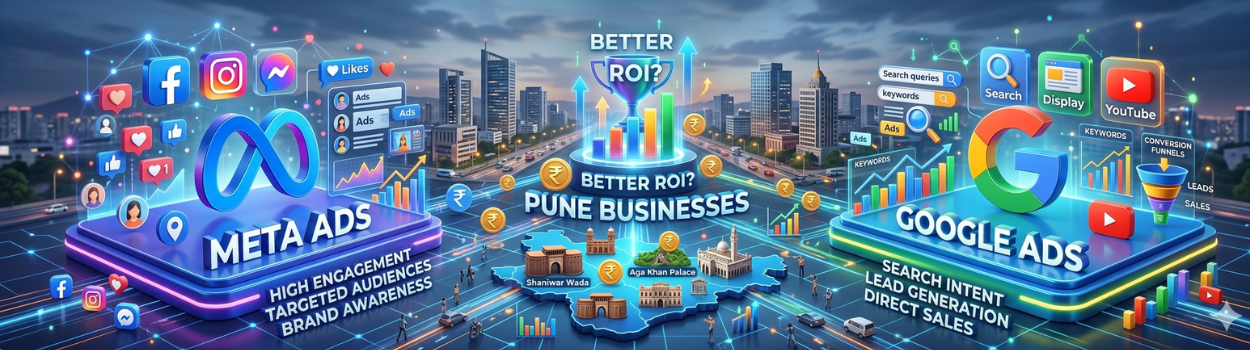
If you’re a business owner in Pune, you’ve probably asked yourself this question at least once:
“Should I invest in Meta Ads or Google Ads?”
With marketing budgets becoming tighter and competition growing every day, choosing the wrong advertising platform can cost you valuable leads, sales, and growth opportunities.
Whether you’re running a startup, local service business, educational institute, healthcare clinic, manufacturing company, or eCommerce brand, understanding the difference between Meta Ads vs Google Ads can significantly impact your return on investment (ROI).
The truth is, there isn’t a one-size-fits-all answer.
The platform that works best depends on your business goals, audience behavior, budget, and sales cycle.
In this guide, we’ll break down both advertising platforms in simple terms so you can make the right decision for your business.
Understanding the Difference Between Meta Ads and Google Ads
Before comparing ROI, let’s understand how these platforms actually work.
What are Meta Ads?
Meta Ads are advertisements displayed across Facebook, Instagram, Messenger, and Meta Audience Network.
These ads focus on audience targeting based on:
- Interests
- Behaviors
- Demographics
- Location
- Online activities
- Customer data
People don’t come to Facebook or Instagram looking for your service. Instead, your ads interrupt their scrolling and create awareness.
This is why social media marketing is often considered a demand-generation channel.
What are Google Ads?
Google Ads display your business when people actively search for products or services.
For example:
- “SEO company in Pune“
- “Best digital marketing agency near me“
- “Website development services Pune”
Unlike social media, Google captures users with existing intent.
They’re already looking for a solution, making them more likely to convert.
This is why many businesses consider Google Ads a demand-capture platform.
Meta Ads vs Google Ads: ROI Comparison for Pune Businesses
1. Lead Quality
Google Ads
Google users are actively searching for solutions.
Examples:
- “Dentist in Baner”
- “CA services Pune”
- “Digital marketing company Pune”
These searches indicate high buying intent.
Result: Better lead quality and faster conversions.
Meta Ads
Meta users are browsing social media, not necessarily looking to buy.
However, advanced targeting allows businesses to reach potential customers before competitors do.
Result: Larger reach but lower immediate intent.
Winner:
✅ Google Ads
For businesses focused on direct lead generation.
2. Brand Awareness
Building trust is critical in today’s competitive market.
Meta Ads
Meta excels at:
- Video marketing
- Brand storytelling
- Customer engagement
- Visual promotions
- Product showcases
A potential customer may see your ad multiple times before making a purchase.
Google Ads
Google focuses more on search intent than brand visibility.
While Display Ads and YouTube campaigns help, Meta still dominates awareness campaigns.
Winner:
✅ Meta Ads
For building brand recognition and audience engagement.
3. Cost Per Lead
Many Pune businesses choose advertising platforms based on budget.
Meta Ads
Generally offers:
- Lower CPC (Cost Per Click)
- Lower CPM (Cost Per 1000 impressions)
- Wider audience reach
This makes Meta attractive for startups and small businesses.
Google Ads
Competitive industries often have higher CPCs.
Examples include:
- Real estate
- Healthcare
- Education
- Legal services
- Finance
However, higher intent often offsets the increased cost.
Winner:
✅ Meta Ads
For lower upfront advertising costs
4. Conversion Rate
A low-cost lead means nothing if it doesn’t convert.
Google Ads
Since users are actively searching, conversion rates tend to be higher.
Businesses often see:
- Faster inquiry generation
- Better quality leads
- Shorter sales cycles
Meta Ads
Requires multiple touchpoints:
- Awareness
- Engagement
- Remarketing
- Conversion
The customer journey is typically longer.
Winner:
✅ Google Ads
For businesses seeking immediate results.
5. Audience Targeting
This is where Meta becomes extremely powerful.
Meta Ads Targeting Options
You can target people based on:
- Age
- Gender
- Interests
- Occupation
- Income level
- Website visitors
- Customer lists
- Similar audiences
This level of precision makes social media marketing highly effective.
Google Ads Targeting
Google primarily relies on:
- Keywords
- Search behavior
- Intent signals
Although powerful, it isn’t as detailed for audience discovery.
Winner:
✅ Meta Ads
For precise audience targeting.
Which Platform Works Best for Different Pune Businesses?
Choose Google Ads If You Are:
- A local service provider
- A healthcare clinic
- A law firm
- An educational institute
- A B2B company
- A real estate consultant
These businesses depend heavily on people actively searching for services.
Choose Meta Ads If You Are:
- An eCommerce brand
- A startup launching a new product
- A restaurant
- A fitness center
- A fashion brand
- A lifestyle business
These businesses benefit greatly from visual storytelling and audience engagement.
Practical Tips to Improve ROI from Both Platforms
For Meta Ads
✔ Use short-form video content
✔ Test multiple creatives
✔ Install Meta Pixel
✔ Create lookalike audiences
✔ Focus on engagement before selling
For Google Ads
✔ Target high-intent keywords
✔ Optimize landing pages
✔ Track conversions properly
✔ Use location targeting
✔ Regularly remove irrelevant search terms
Common Mistake Pune Businesses Make
Many businesses launch campaigns without:
- Conversion tracking
- Audience research
- Landing page optimization
- Clear sales funnels
As a result, they assume the platform failed when the real issue is campaign strategy.
Advertising success isn’t about choosing Meta or Google.
It’s about choosing the right strategy.
Final Verdict: Meta Ads vs Google Ads
If your goal is:
Immediate Leads & Sales
✅ Google Ads
Brand Awareness & Audience Growth
✅ Meta Ads
Maximum ROI
✅ Use Both Together
For most Pune businesses, the winning formula is:
Meta Ads + Google Ads + SEO + Conversion-Optimized Landing Pages
This creates a complete digital marketing ecosystem that generates awareness, captures intent, and converts prospects into customers.

