
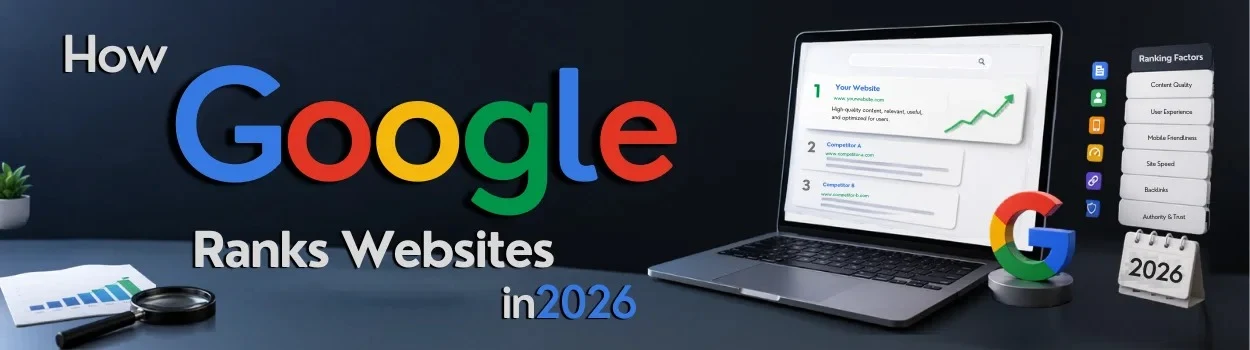
If you are wondering how Google ranks websites in 2026, you are not alone. With AI-powered search results, evolving ranking algorithms, and increasing competition online, ranking on Google has become more challenging than ever before.
Businesses today are fighting not only for page-one rankings but also for visibility inside AI Overviews, featured snippets, and voice search results. This means traditional SEO tactics alone are no longer enough.
In 2026, Google focuses heavily on:
- Helpful and original content
- User experience
- Search intent
- EEAT signals
- Website performance
- AI-driven search understanding
Understanding the latest Google ranking factors 2026 can help businesses improve visibility, generate leads, and grow organically without depending entirely on paid ads.
In this guide, you will learn exactly how Google ranks websites step by step, the latest SEO ranking factors, and practical strategies to improve your rankings in 2026.
What Does Google Use to Rank Websites in 2026?
Google uses advanced algorithms and AI systems to analyze billions of webpages and determine which content deserves higher rankings.
The process mainly includes:
- Crawling
- Indexing
- Ranking
Google bots first crawl websites, understand their content, and store pages in Google’s index. After that, Google’s ranking systems evaluate hundreds of signals to decide which pages appear first in search results.
The biggest change in Google SEO guide 2026 is the increased use of AI and user-behavior analysis.
Understanding Google’s Ranking Algorithm
Google’s algorithm is designed to deliver the most relevant and useful results for every search query.
Some important ranking systems include:
- Helpful Content System
- RankBrain
- BERT
- SpamBrain
- Core Ranking Systems
These systems work together to evaluate:
- Content quality
- Search intent relevance
- Website authority
- User engagement
- Technical performance
Google no longer ranks websites simply because they use keywords repeatedly. Instead, it focuses on understanding the meaning and usefulness behind content.
How AI Is Changing Search Rankings
AI is transforming the future of SEO rapidly.
With Google AI Overview and Search Generative Experience (SGE), search results are becoming more conversational and contextual. Google now understands:
- User intent
- Context
- Search history
- Content quality
- Topic relationships
This means websites must create deeper, experience-driven content instead of generic blogs.
Businesses searching for how to rank on Google in 2026 should focus on building topical authority rather than publishing random keyword-focused articles.
Why User Experience Matters More Than Ever
User experience has become a major Google ranking factor in 2026.
Google evaluates how users interact with your website. If visitors leave quickly or struggle to navigate your site, rankings can drop.
Important UX signals include:
- Mobile responsiveness
- Fast loading speed
- Easy navigation
- Low bounce rate
- High engagement time
Google wants websites that genuinely help users.
Top Google Ranking Factors in 2026
Helpful, Human-First Content
- Solve real problems
- Answer questions clearly
- Include practical insights
- Demonstrate expertise
- Offer unique value
EEAT Signals (Experience, Expertise, Authority, Trust)
One of the biggest SEO trends in 2026 is EEAT.
Google uses EEAT to evaluate content quality.
EEAT = Experience + Expertise + Authoritativeness + Trustworthiness
Google checks:
- Whether the author has real experience
- Brand credibility
- Industry expertise
- Website trustworthiness
- Online reputation
Adding case studies, testimonials, author bios, and real-world examples can improve EEAT signals significantly.
Search Intent Optimization
Search intent optimization is critical for SEO success.
Google ranks pages based on how well they satisfy user intent.
Main search intent types:
- Informational
- Commercial
- Transactional
- Navigational
For example:
Someone searching “how Google ranks websites 2026” wants educational and practical information — not a sales page.
Understanding intent helps improve:
- Click-through rates
- Engagement
- Rankings
Core Web Vitals and Technical SEO
Technical SEO still plays a major role in rankings.
Important technical SEO factors include:
- Page speed
- Mobile optimization
- Secure HTTPS connection
- Clean website architecture
- Fast loading performance
Google’s Core Web Vitals measure:
- Loading performance
- Interactivity
- Visual stability
Better technical performance improves both rankings and user experience.
Backlinks and Topical Authority
Backlinks remain one of the strongest ranking signals in 2026.
However, Google now prioritizes:
- Relevant backlinks
- High-authority domains
- Natural link profiles
- Topic relevance
A single backlink from an authoritative industry website is more valuable than hundreds of spammy links.
Building topical authority through consistent content publishing also improves SEO rankings.
How Google Evaluates Content Quality in 2026
Originality and First-Hand Experience
Google prefers original content that demonstrates real-world experience.
Content that performs well often includes:
- Case studies
- Industry insights
- Personal experiences
- Real screenshots
- Data-driven examples
Generic rewritten content struggles to compete against experience-based articles.
Content Freshness and Updates
Regularly updating content has become extremely important.
Google wants users to see accurate and up-to-date information.
Updating blogs with:
- Latest statistics
- New SEO trends
- Updated screenshots
- Fresh examples
can improve rankings significantly.
Many businesses lose rankings because they publish content once and never update it.
Engagement Signals
Google tracks how users interact with content.
Strong engagement signals include:
- High click-through rates
- Longer time on page
- Scroll depth
- Low bounce rate
Engaging formatting helps improve these metrics:
- Short paragraphs
- Bullet points
- Tables
- Images
- FAQs
Technical SEO Factors That Influence Rankings
Website Architecture
A well-structured website helps Google crawl and understand pages better.
Good website architecture includes:
- Clear navigation
- Internal linking
- Category structure
- XML sitemap
- Proper URL hierarchy
Internal linking also distributes authority across pages.
Mobile-First Indexing
Google uses mobile-first indexing, meaning it primarily evaluates the mobile version of websites.
Websites that are not mobile-friendly may struggle to rank.
Important mobile SEO practices:
- Responsive design
- Fast mobile speed
- Readable text
- Optimized images
- Easy navigation
Structured Data and Schema Markup
Structured data helps Google understand website content better.
Popular schema types include:
- FAQ schema
- Article schema
- Breadcrumb schema
- Review schema
Schema markup can improve:
- Rich snippets
- CTR
- Search visibility
Indexing and Crawl Optimization
Search engines must crawl and index pages efficiently.
Common SEO mistakes include:
- Broken links
- Duplicate content
- Incorrect canonical tags
- Blocked pages in robots.txt
Regular SEO audits help identify indexing issues early.
How AI Search and Google SGE Impact SEO
Google’s AI-powered search experience is changing SEO strategies.
AI Overview often summarizes answers directly in search results, reducing clicks for low-quality content.
To rank in AI search:
- Create expert-driven content
- Answer questions clearly
- Use structured headings
- Add factual information
- Build authority
Businesses that focus on quality and trust will benefit the most.
Common SEO Mistakes That Hurt Rankings
Keyword Stuffing
Overusing keywords damages readability and rankings.
Instead of stuffing keywords repeatedly, focus on natural optimization.
Thin AI Content
Publishing mass-produced AI content without editing can harm rankings.
Google rewards quality over quantity.
Ignoring Technical SEO
Even great content may fail if:
- Pages load slowly
- Mobile experience is poor
- Crawl issues exist
Technical SEO is essential for sustainable rankings.
Poor User Experience
Complicated navigation and intrusive popups frustrate users.
Google notices these negative signals.
Buying Low-Quality Backlinks
Spammy backlinks can trigger Google penalties.
Focus on earning links naturally through quality content and digital PR.
Step-by-Step SEO Strategy to Rank Higher in 2026
Perform Keyword Research
Find keywords with:
- Good search volume
- Clear intent
- Lower competition
- Relevant business value
Use:
- Google Search Console
- Keyword Planner
- SEO tools
Create Topic Clusters
Instead of isolated blogs, build topic clusters around major subjects.
Example:
- SEO guide
- Technical SEO
- Local SEO
- AI SEO
- Google ranking factors
This improves topical authority.
Optimize On-Page SEO
Important on-page SEO elements:
- Title tags
- Meta descriptions
- Internal links
- Image optimization
- Keyword placement
- Header structure
Build High-Authority Backlinks
Effective backlink strategies include:
- Guest blogging
- Digital PR
- Industry collaborations
- Data-driven content
Quality matters more than quantity.
Improve User Engagement
Increase engagement by:
- Adding visuals
- Using interactive content
- Improving readability
- Writing compelling introductions
User satisfaction directly impacts rankings.
Continuously Update Content
SEO is ongoing.
Refreshing old content can:
- Recover rankings
- Increase traffic
- Improve conversions
Regular updates are now a key SEO strategy in 2026.
Future of Google Search Rankings Beyond 2026
The future of SEO will become even more AI-driven.
Emerging trends include:
- Voice search optimization
- Visual search
- Personalized search results
- AI-generated summaries
- Brand authority signals
Businesses that focus on trust, expertise, and user value will continue to win
Final Thoughts
Understanding how Google ranks websites in 2026 is essential for businesses that want long-term online growth.
SEO today is no longer just about keywords and backlinks. Google now prioritizes:
- Helpful content
- User experience
- EEAT
- Technical SEO
- Authority
- Engagement
Businesses that adapt to these modern SEO trends can achieve sustainable rankings and higher organic traffic.
If you want better rankings, focus on creating value-driven content that genuinely helps users.
For businesses looking to improve their SEO strategy, Niranjan Enterprises provides SEO, content marketing, and digital growth solutions designed for modern Google ranking systems

