
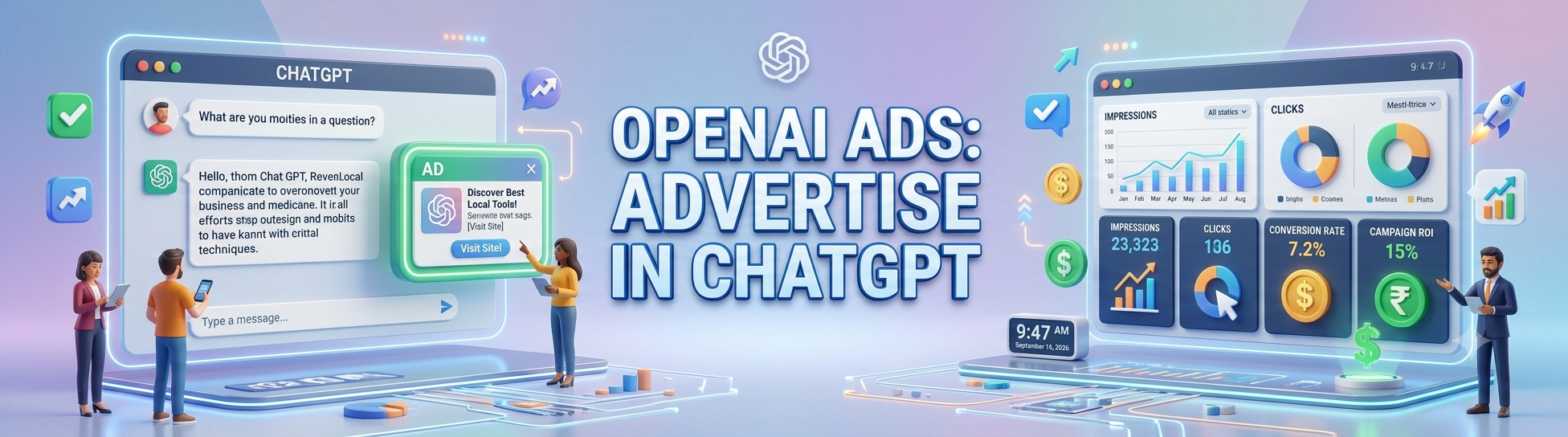
The way people discover products, services, and businesses is changing. Traditional search engines largely depend on users typing keywords and then scanning pages of results. AI-powered platforms such as ChatGPT introduce a different discovery experience: people can describe what they need in natural language, explain their preferences, compare alternatives, and ask follow-up questions before deciding what to do next.
That shift is creating a new advertising opportunity. OpenAI Ads allows businesses to advertise within ChatGPT, giving brands a way to appear while potential customers are exploring options, comparing products, and making decisions. OpenAI says ChatGPT Ads are now available across more than 40 countries, with self-service access expanding to India and other regions through Ads Manager.
For small businesses, startups, and entrepreneurs, this matters because ChatGPT can be part of the customer journey before a person ever visits a company’s website. Instead of competing only for a traditional Google search result, businesses can explore advertising in an environment where customers are already discussing their needs.
What Are OpenAI Ads?
OpenAI Ads are paid advertisements displayed within ChatGPT. They are designed to help businesses reach people when they are researching, comparing, and deciding. According to OpenAI, advertisements appear separately from ChatGPT’s generated answers and are clearly identified as ads.
This is different from simply trying to make ChatGPT mention your company organically. Organic visibility depends on factors such as your content, reputation, website information, and how AI systems understand your business. Advertising, on the other hand, provides a paid distribution mechanism.
The distinction is important for marketers. ChatGPT Ads should not be treated as a replacement for SEO, content marketing, Google Ads, or social media advertising. Instead, they represent another channel that can potentially reach customers during high-intent research.
OpenAI’s current advertising system considers contextual signals, including the topic and intent of the conversation, along with information supplied by advertisers. Depending on user settings, certain signals from a user’s broader ChatGPT experience may also contribute to ad relevance.
Key points:
- OpenAI Ads are paid placements inside ChatGPT.
- Ads are clearly labeled and separated from ChatGPT’s answers.
- Advertisers do not receive users’ private conversations or chat history.
- Campaigns can use CPM, CPC, and conversion-oriented buying options.
- Availability and capabilities can continue to change as OpenAI expands the platform.

How Does Advertising in ChatGPT Work?
When you advertise in ChatGPT, the fundamental idea is to reach users based on the context of what they are trying to accomplish rather than relying exclusively on a conventional keyword search.
Imagine a business owner asking ChatGPT, “What CRM should I use for a 10-person sales team?” In another conversation, someone may ask, “What are the best accounting software options for a small business?” A third user might be researching website development companies for a new startup.
These conversations contain substantially more context than a short search query. The user may explain their budget, business size, location, industry, requirements, and preferences. OpenAI’s advertising system is designed to use relevant contextual signals to determine which eligible advertisements may be appropriate.
OpenAI’s current Ads Manager allows advertisers to create campaigns, establish budgets, select countries and platforms, create ad groups, upload advertisements, and monitor performance. Campaign objectives currently include CPM, CPC, and oCPC, depending on the campaign setup.
A typical process looks like this:
- Create an OpenAI Ads Manager account.
- Set up your campaign objective, budget, dates, and targeting.
- Create ad groups around relevant products, services, or use cases.
- Add multiple headlines, descriptions, creatives, and landing pages.
- Launch the campaign and monitor clicks, impressions, conversions, and costs.
Where Do ChatGPT Ads Appear?
Understanding the placement is important before investing in ChatGPT Ads. OpenAI’s current ad format appears below ChatGPT responses rather than being inserted into the answer itself. The ad unit can include the advertiser name, logo/favicon, headline, description, landing page, and an image creative.
That separation is particularly important because advertising in an AI environment needs to maintain a distinction between paid promotion and the AI-generated response. OpenAI states that advertisements do not influence ChatGPT’s answers and that ads are visually separated from those answers.
For marketers, this means your advertisement needs to work independently. You cannot assume that ChatGPT’s response will explain your company for you. The ad itself needs to communicate the value proposition quickly and accurately.
This makes the quality of the headline, description, creative, offer, and landing page especially important.
Effective ChatGPT advertising should therefore focus on:
- A clear description of what you sell.
- A specific customer problem or use case.
- A practical benefit rather than vague marketing language.
- A relevant landing page that continues the same message.
- Multiple creative variations so the system has different angles to evaluate.
Who Can Benefit From OpenAI Ads?
OpenAI Ads can be relevant to a wide range of businesses, but the opportunity is particularly interesting for companies whose customers spend time researching before making a purchase.
For example, a B2B software company may want to reach business owners researching CRM platforms. A digital marketing agency may want to reach entrepreneurs looking for SEO or advertising services. An ecommerce brand may want to appear while customers compare products.
The strongest opportunities are likely to come from situations where the customer journey involves research → comparison → consideration → action. ChatGPT is increasingly used across that type of journey, which makes the platform interesting for both awareness and performance marketing strategies.
OpenAI has specifically stated that Ads Manager is designed to make ChatGPT advertising accessible to businesses ranging from SMBs and startups to larger brands.
Potential business categories include:
- SaaS and technology companies.
- Professional services and agencies.
- Ecommerce and consumer brands.
- Education and online learning businesses.
- Local and regional service businesses.
- Travel, lifestyle, and other research-driven categories where permitted by advertising policies.
OpenAI Ads vs Google Ads: What's the Difference?
It is tempting to compare OpenAI Ads directly with Google Ads, but the two platforms operate in different environments.
Google Search Ads traditionally respond to explicit searches. A person enters a query such as “digital marketing agency Pune” or “best CRM for small business,” and advertisers compete for available placements associated with that search.
ChatGPT provides a conversational environment. A person may write a detailed description of their situation and continue asking questions. Instead of one isolated keyword, the platform can have considerably more contextual information about what the person is trying to accomplish.
That does not automatically make one platform better than the other. They serve different discovery behaviors, and businesses should evaluate each channel according to their objectives, audience, economics, and conversion data.
| Google Ads | ChatGPT Ads |
|---|---|
| Primarily search-driven | Conversation and context-driven |
| Strong connection to explicit queries | Designed around conversational intent |
| Keyword strategy is important | Context and relevance signals matter |
| Search-result advertising environment | AI conversation environment |
| Established search advertising ecosystem | Newer AI-native advertising channel |
How Much Do ChatGPT Ads Cost?
The cost of ChatGPT Ads depends on the campaign objective, bidding, competition, and delivery. OpenAI currently supports both CPM and CPC buying, while its Ads Manager documentation also describes oCPC, or conversion-optimized cost-per-click, campaigns.
For CPM campaigns, advertisers pay based on impressions. CPC campaigns focus spending around valid clicks, while conversion-oriented campaigns are designed around downstream actions after someone interacts with an advertisement.
OpenAI’s Help Center currently recommends starting CPC maximum bids around $3–$5 USD per click, while noting that actual delivery depends on factors such as bid competitiveness and the auction. This should be treated as platform guidance rather than a guaranteed cost or expected CPL.
Businesses should therefore avoid choosing a budget based solely on a benchmark. Instead, establish an acceptable acquisition cost and test the economics.
Consider tracking:
- Impressions and reach.
- Click-through rate.
- Average CPC or CPM.
- Landing-page engagement.
- Leads or purchases.
- Cost per conversion.
- Revenue and return on ad spend.
How to Create Better ChatGPT Ads
Creating an advertisement for an AI-powered environment requires a slightly different mindset from writing a conventional display ad.
OpenAI recommends clear, specific, benefit-focused messaging. Its advertising guidance also recommends creating multiple distinct title and description variations rather than repeatedly presenting essentially the same message.
This is particularly useful for small businesses because your first advertisement does not need to be perfect. The goal should be to establish a structured testing system.
For example, a digital marketing agency could test different positioning angles:
For example, a digital marketing agency could test different positioning angles:
Ad angle 1: Lead generation
“Generate More Qualified Leads With Performance Marketing”
Ad angle 2: Local growth
“Digital Marketing Services for Pune Businesses“
Ad angle 3: Business outcome
“Turn Website Traffic Into Consistent Enquiries”
Each variation speaks to a different customer motivation while representing the same underlying service.
Good ChatGPT advertising should prioritize:
- Specific customer benefits.
- Clear, factual claims.
- Concise headlines.
- Different messaging angles.
- Landing pages that match the advertisement.
Why Landing Pages Matter More Than Ever
Getting a click is only one part of the customer journey. If someone clicks your ChatGPT advertisement and lands on a generic homepage with unclear messaging, expensive advertising can quickly become inefficient.
Your landing page should continue the conversation started by the ad. If your advertisement promises “SEO Services for Small Businesses,” the landing page should immediately explain your SEO service, who it is designed for, what is included, why your approach is different, and what the visitor should do next.
This is where conversion-focused content becomes important. A strong landing page reduces the gap between advertisement → relevance → trust → action.
Before launching an OpenAI Ads campaign, review:
- Headline-to-landing-page message consistency.
- Mobile experience.
- Page loading speed.
- Lead form simplicity.
- Trust signals such as testimonials, case studies, certifications, or portfolio examples.
- Clear calls to action.
Should Small Businesses Advertise in ChatGPT?
The answer should come from testing rather than assumptions. ChatGPT Ads are a relatively new advertising channel, and performance can vary significantly by industry, market, offer, audience, creative, and landing-page quality.
The good news for smaller businesses is that OpenAI has expanded self-service advertising access and specifically describes Ads Manager as a way for SMBs and startups to participate.
For a small business, the practical approach is to begin with a clearly defined business objective rather than simply buying impressions. A company selling high-value services might focus on qualified leads. An ecommerce business might focus on purchases. A local business might test traffic and enquiry generation.
Start with:
- One clearly defined customer segment.
- One specific business objective.
- A focused landing page.
- Several ad variations.
- A measurable conversion event.
- A controlled test budget.
How Digital Marketing Agencies Can Prepare for ChatGPT Ads
For agencies, Advertise in ChatGPT is not simply another advertising platform to add to a service list. It represents a change in how paid media can interact with AI-driven consumer decision-making.
Agencies will need to understand conversational intent, contextual relevance, landing-page quality, conversion tracking, creative testing, and AI-search behavior. The strongest campaigns will likely require collaboration between paid media specialists, SEO strategists, content marketers, conversion copywriters, and analytics teams.
This also creates an opportunity for agencies to educate clients rather than immediately promising performance. Because the platform is still evolving, campaigns should be approached as measurable experiments with clear hypotheses and conversion goals.
A modern agency’s AI advertising workflow can include:
- Audience and conversational-intent research.
- Campaign and ad-group planning.
- Benefit-focused ChatGPT ad copy.
- Multiple creative variations.
- Landing-page development and CRO.
- Conversion tracking and performance analysis.
Final Thoughts: Is ChatGPT Advertising the Next Marketing Channel?
OpenAI Ads are creating a new advertising environment around conversational discovery. Instead of reaching someone only when they enter a traditional keyword, businesses can potentially appear while customers are explaining problems, researching solutions, comparing alternatives, and deciding what to do next.
For small businesses and startups, the opportunity is worth understanding now because AI-powered discovery is becoming an increasingly important part of the digital customer journey. But successful advertising will still depend on fundamentals: a strong offer, accurate positioning, relevant messaging, trustworthy content, effective landing pages, and disciplined measurement.
OpenAI’s current platform supports CPM, CPC, and conversion-oriented campaigns, while Ads Manager provides tools for campaign creation, measurement, and optimization. Availability has also expanded significantly, including self-service access in India as of August 31, 2026.
The important takeaway is simple: ChatGPT Ads should be viewed as a new paid-media channel—not a replacement for SEO or traditional digital marketing. Businesses that combine AI-search visibility, high-quality content, conversion optimization, and carefully measured paid campaigns will be better positioned to understand how customers discover brands in an AI-first environment.
If your business is considering ChatGPT Ads, the right starting point is not simply asking, “How do I place an ad?” It is asking, “What is my customer trying to accomplish, and how can my business become the most relevant next step?”
That is where AI-native advertising becomes more than another advertising placement—it becomes part of a broader strategy for reaching customers at the moment they are actively making decisions.

