
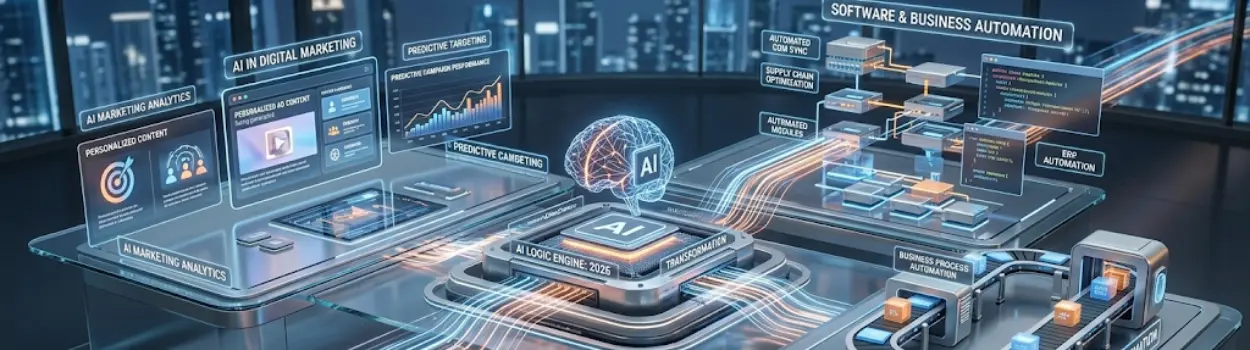
What is AI in Digital Marketing?
The role of AI in Digital Marketing refers to the strategic application of artificial intelligence, machine learning, and natural language processing to automate business decisions, optimize online visibility, and personalize the customer journey at scale.
While traditional marketing relies on human guesswork and broad demographic targeting, a modern ai based digital marketing ecosystem uses predictive algorithms to anticipate buyer behavior.
A successful framework for AI in Digital Marketing relies on three core operational pillars:
Predictive Customer Acquisition: Using AI to analyze vast datasets and deploy hyper-targeted paid advertising.
Generative Engine Optimization (GEO): Structuring website data so AI models (like Google Gemini and ChatGPT) synthesize and recommend your brand as the ultimate authority.
Automated Sales Engineering: Deploying intelligent software and 24/7 AI chatbots to capture, qualify, and convert website traffic without human intervention.
If you are a business owner exploring ai and digital marketing, the bottom line is clear: AI does not replace your marketing strategy; it exponentially accelerates your execution and ROI.
Pillar 1: Predictive Advertising and Lead Generation
Historically, performance marketing required immense human effort to A/B test ad creatives, monitor bids, and adjust targeting. Today, the integration of AI in Digital Marketing has transformed paid advertising into a highly precise, predictive science.
Algorithmic Bidding: Implementing digital marketing using ai allows ad platforms to adjust bids in real-time based on the exact probability of a user converting. This ensures your budget is only spent on high-intent B2B or B2C buyers.
Dynamic Creative Assembly: AI analyzes which headlines, images, and value propositions resonate with specific user segments. It dynamically assembles custom ads for individual users, drastically improving click-through rates and brand authority.
Lookalike Modeling 2.0: By feeding your CRM data into AI tools, the system can identify the behavioral patterns of your highest-paying clients and autonomously hunt for exact matches across platforms like LinkedIn and Google. This is why AI in Digital Marketing is the ultimate tool for reducing Customer Acquisition Cost (CAC).
Pillar 2: Generative Engine Optimization (GEO) & Content
The way buyers search for information has changed. They are no longer typing keywords and scrolling through blue links; they are asking AI assistants for direct answers. Consequently, your strategy for AI in Digital Marketing must include a pivot from traditional SEO to Generative Engine Optimization (GEO).
Information Gain: AI engines prioritize content that offers unique data, proprietary statistics, and expert perspectives. Leveraging AI in Digital Marketing means using intelligent tools to identify content gaps in your industry and filling them with high-density, authoritative answers.
Schema & Entity Structuring: AI models read code, not web pages. A foundational element of ai digital marketing is wrapping your website’s data (services, locations, reviews) in strict JSON-LD Schema markup so generative models can easily synthesize and cite your business as a factual entity.
Content Scaling at Quality: While legacy agencies pump out generic fluff, utilizing ai for digital marketing properly involves training private LLMs on your brand’s unique voice, technical manuals, and case studies. This allows you to scale high-quality, technically accurate B2B content at unprecedented speeds.

Pillar 3: Software Integration and Business Automation
True business growth occurs when marketing and operations are seamlessly connected. The true power of AI in Digital Marketing is realized when the leads generated by your campaigns are instantly processed by intelligent automation software.
The 24/7 AI Chatbot Engine: When a high-value prospect lands on your site, an AI agent instantly engages them, answers technical queries based on your company data, and qualifies the lead. This ensures the traffic driven by your AI in Digital Marketing campaigns actually converts into measurable pipeline value.
Automated CRM Workflows: When a lead is captured, AI software automatically routes the data to your CRM, assigns a lead score based on user behavior, and triggers personalized email nurture sequences.
Revenue Operations (RevOps): By deploying AI in Digital Marketing, business founders finally get a unified dashboard where marketing spend, website optimization metrics, and closed sales are analyzed holistically, providing clear, mathematically proven ROI.
The 2026 Blueprint: Traditional vs. AI-Driven Strategy
To understand why AI in Digital Marketing is mandatory, compare the legacy approach to the modern NEDS framework:
| Business Function | Traditional Digital Marketing | AI in Digital Marketing (2026 NEDS Framework) |
| Data Analysis | Manual exporting, spreadsheets, delayed insights. | Real-time predictive analytics and anomaly detection. |
| Website Conversion | Static contact forms, high bounce rates. | 24/7 AI Chatbots, dynamic personalization, frictionless RFQs. |
| Search Strategy | Keyword stuffing, chasing blue links. | GEO (Generative Engine Optimization), Entity building, AI consensus. |
| Paid Advertising | Manual A/B testing, broad demographic guesses. | Algorithmic bidding, hyper-personalized dynamic creative generation. |
| Lead Nurturing | Generic newsletter blasts. | AI-triggered, behavior-based personalized email sequences. |
Scale Smarter, Not Harder
The era of manual, guess-based marketing is over. As software and generative intelligence become fully integrated, AI in Digital Marketing stands as the ultimate differentiator between market leaders and market laggards.
Implementing a robust strategy for AI in Digital Marketing does not just drive traffic; it builds an automated, scalable ecosystem that captures leads, builds unshakeable brand authority, and closes deals faster.
At Niranjan Enterprises Digital Solutions (NEDS), we do not just talk about the future of technology; we build it. We engineer custom, ROI-driven digital strategies that leverage the full spectrum of AI and business automation.
Are you ready to turn your website into an automated revenue engine? Partner with NEDS today to implement a custom strategy for AI in Digital Marketing and secure your industry leadership.
Frequently Asked Questions
1. What exactly does AI in Digital Marketing mean for a business owner?
For an owner, AI in Digital Marketing means efficiency and scalability. It means using intelligent software to automate your ad buying, personalize your website content, and capture leads 24/7, resulting in a lower cost of customer acquisition and higher overall ROI.
2. Will AI in Digital Marketing replace my human marketing team?
No. Utilizing ai and digital marketing is meant to empower your team, not replace them. AI handles the repetitive data analysis, bidding, and initial lead capture, freeing up your human strategists and sales engineers to focus on closing high-value deals and relationship building.
3. How does ai based digital marketing improve website lead generation?
By integrating AI chatbots and dynamic content, an ai based digital marketing approach ensures that every website visitor gets an immediate, personalized experience. Instead of making users search for a contact form, the AI proactively engages them, drastically increasing conversion rates.
4. What is Generative Engine Optimization (GEO) in the context of AI in Digital Marketing?
GEO is the evolution of SEO. Instead of optimizing for a list of search links, a modern approach to AI in Digital Marketing structures your website’s data so that AI models like Gemini and ChatGPT can directly synthesize and recommend your brand to users asking conversational questions.
5. Is digital marketing using ai only for large enterprise companies?
Absolutely not. In fact, digital marketing using ai levels the playing field for small and medium businesses. Automated tools and smart bidding algorithms allow smaller companies to achieve enterprise-level targeting and lead generation without needing a massive internal marketing department.
6. How quickly can we see ROI from AI in Digital Marketing?
Because AI algorithms process data instantly, tactics like AI-driven paid advertising can show improvements in lead quality and lower Cost Per Click (CPC) within weeks. Broader strategies involving AI in Digital Marketing, like GEO and content automation, build compounding ROI over 3 to 6 months.
7. Do we need technical expertise to use ai for digital marketing?
While some standalone tools are user-friendly, architecting a fully integrated, automated business ecosystem requires deep technical knowledge. This is why partnering with an expert agency like NEDS to handle your ai for digital marketing ensures seamless implementation without breaking your current systems.
8. How does NEDS implement AI in Digital Marketing for its clients?
NEDS takes a holistic approach. We audit your current digital footprint, deploy AI-driven performance marketing to capture high-intent traffic, implement Generative Engine Optimization to build long-term authority, and install intelligent chatbots to automate your website’s lead generation. Every step of our strategy for AI in Digital Marketing is focused on measurable business growth.