
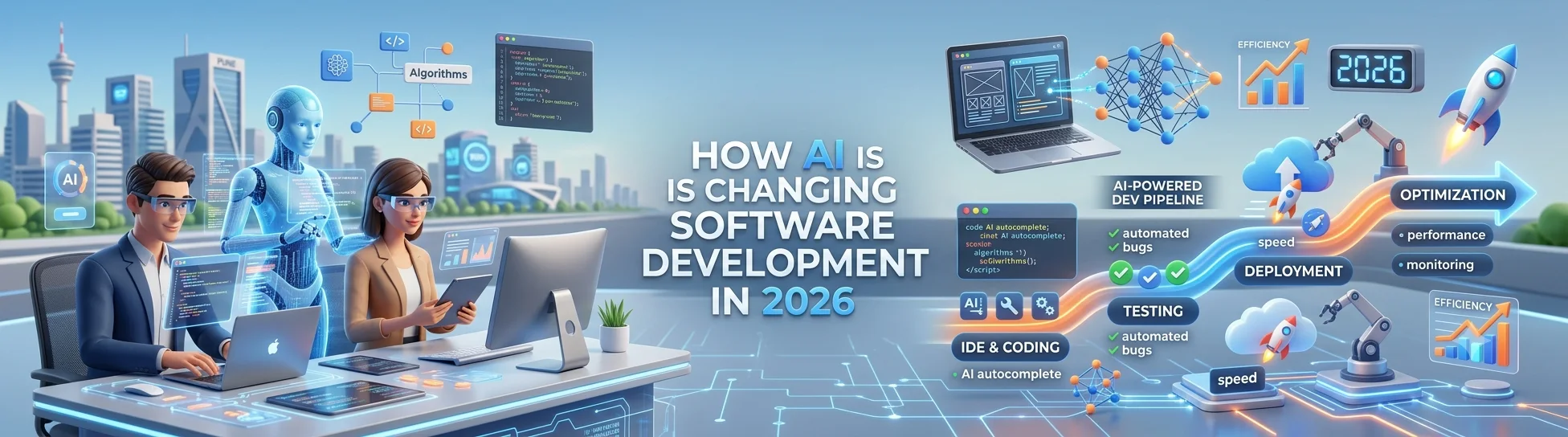
Software development is changing faster than it has in decades. In 2026, artificial intelligence is no longer limited to experimental coding assistants or simple autocomplete features. AI in software development is now influencing how teams plan applications, write and review code, test features, identify bugs, document projects, and maintain software after launch.
For small businesses, startups, and entrepreneurs, this shift is particularly important. Building software traditionally required significant development time, specialized technical skills, and ongoing resources. AI development tools are helping teams reduce repetitive work and spend more time solving business problems, improving user experiences, and creating features that differentiate their products.
However, AI is not replacing software developers. Instead, it is changing what developers spend their time doing. The most effective teams are combining human expertise with AI coding tools to make development faster while maintaining security, reliability, scalability, and business alignment.
What Is AI in Software Development?
AI in software development refers to using artificial intelligence throughout the software development lifecycle. Instead of using AI only to generate code, modern development workflows can use AI for requirements analysis, architecture discussions, coding, debugging, testing, documentation, code reviews, and maintenance.
The technology has also become more capable of understanding context. Developers can provide an existing codebase, explain a business requirement, or describe a feature in natural language and receive suggestions that are relevant to the project. This makes AI increasingly useful for both experienced developers and teams that have limited technical resources.
For example, a startup developing a CRM application could use AI to generate an initial API structure, create database queries, identify potential edge cases, generate test cases, and explain unfamiliar code. A developer can then review, modify, test, and integrate the output into the production system.
Key applications include:
- AI-assisted code generation and completion
- Automated debugging and error analysis
- Test-case and documentation generation
- Code review and quality analysis
- Software architecture and development planning

What Is AI in Software Development?
AI in software development refers to using artificial intelligence throughout the software development lifecycle. Instead of using AI only to generate code, modern development workflows can use AI for requirements analysis, architecture discussions, coding, debugging, testing, documentation, code reviews, and maintenance.
The technology has also become more capable of understanding context. Developers can provide an existing codebase, explain a business requirement, or describe a feature in natural language and receive suggestions that are relevant to the project. This makes AI increasingly useful for both experienced developers and teams that have limited technical resources.
For example, a startup developing a CRM application could use AI to generate an initial API structure, create database queries, identify potential edge cases, generate test cases, and explain unfamiliar code. A developer can then review, modify, test, and integrate the output into the production system.
Key applications include:
- AI-assisted code generation and completion
- Automated debugging and error analysis
- Test-case and documentation generation
- Code review and quality analysis
- Software architecture and development planning
AI Coding Is Making Development Faster
One of the most visible changes in software development is the growth of AI coding. Developers can now describe what they want to build using natural language and receive code suggestions, functions, components, queries, and configuration files.
This does not mean developers can simply ask an AI tool to build an entire production application and deploy it without supervision. Generated code can contain security vulnerabilities, incorrect assumptions, inefficient implementations, or compatibility issues. Human review remains essential.
The biggest advantage is the reduction of repetitive development work. Developers can spend less time writing boilerplate code and more time thinking about architecture, business logic, performance, and user experience.
AI coding can be particularly valuable when building common components such as authentication flows, CRUD operations, API integrations, form validation, database models, and testing structures.
Important benefits include:
- Faster development of repetitive code
- Natural-language assistance for technical tasks
- Faster prototyping of new ideas
- Assistance with debugging and refactoring
- More time for developers to focus on complex problems
AI Development Tools Are Becoming Part of the Developer Workflow
The market for AI development tools has expanded significantly. AI capabilities are now appearing inside coding environments, development platforms, documentation systems, testing workflows, and project-management processes.
Modern tools can understand larger portions of a codebase rather than operating only on the line currently being edited. This allows developers to ask questions about how different components work together, identify dependencies, and make changes across multiple files.
For businesses, this can shorten the distance between an idea and a working prototype. A business owner might explain a workflow such as “customer submits an inquiry, sales team receives a notification, and the lead enters the CRM,” while the development team uses AI to accelerate implementation.
The important consideration is not simply choosing the tool with the most AI features. Businesses should evaluate how well an AI development tool fits their existing technology stack, security requirements, development workflow, and team capabilities.
When evaluating AI development tools, consider:
- Integration with your existing development environment
- Code quality and reliability
- Data privacy and security controls
- Support for your programming languages and frameworks
- Ability to work with your existing codebase
AI Is Changing Software Testing and Debugging
Testing has traditionally consumed a significant amount of development time. Developers need to identify possible failure scenarios, create test cases, reproduce bugs, and verify that changes do not break existing functionality.
AI can assist with many of these activities. It can analyze code and suggest potential edge cases, generate unit tests, explain error messages, and identify areas that may require additional testing.
Consider an e-commerce application. A developer changes the checkout process. Instead of manually thinking through every possible scenario from scratch, AI can help identify cases such as failed payments, expired sessions, invalid coupon codes, missing addresses, duplicate submissions, and unexpected API responses.
Human testing is still necessary, especially for critical systems. AI-generated tests need to be reviewed because AI may misunderstand business requirements or create tests that technically execute but do not validate meaningful behavior.
AI-assisted testing can help with:
- Generating unit and integration tests
- Identifying potential edge cases
- Analyzing application errors
- Supporting regression testing
- Explaining complex bugs and possible fixes
AI Is Changing the Role of Software Developers
The developer’s role is also evolving. Previously, a significant portion of development work involved manually translating requirements into code. As AI handles more repetitive implementation tasks, developers increasingly need to focus on higher-level decisions.
This includes understanding business requirements, designing system architecture, evaluating AI-generated code, managing security, optimizing performance, and deciding how different technologies should work together.
In other words, knowing how to write code remains valuable, but understanding why the code should be written a certain way is becoming even more important.
For startups and small businesses, this creates an opportunity to build leaner development teams without eliminating human expertise. A small team can potentially accomplish more when developers use AI as a productivity layer.
Developers increasingly need skills in:
- System architecture and technical decision-making
- AI-assisted development workflows
- Security and code-quality review
- Business and product understanding
- Testing and production monitoring

AI Can Help Small Businesses Build Software More Efficiently
Small businesses often face a difficult software-development equation: they need customized technology but may have limited budgets, technical staff, and development resources.
AI can reduce some of the repetitive effort involved in software development. This can make it easier to prototype internal tools, customer portals, dashboards, CRM systems, automation platforms, and business applications.
For example, a growing company could develop an internal sales dashboard that connects customer data, lead status, sales activity, and reporting. AI can help developers create portions of the interface, APIs, database queries, documentation, and testing workflows.
The result is not automatically cheaper or better software. The outcome depends on how effectively AI is integrated into the development process. Poorly reviewed AI-generated code can create technical debt that becomes expensive later.
Businesses should therefore focus on AI-assisted development, not simply “AI-generated software.”
Potential business benefits include:
- Faster prototyping and MVP development
- Reduced repetitive development effort
- Faster implementation of business automation
- More efficient maintenance and documentation
- Greater flexibility for customized software
What AI Cannot Replace in Software Development
Despite rapid progress, AI still has important limitations. Software is not simply a collection of code. Successful applications depend on understanding users, business processes, security requirements, regulations, technical constraints, and long-term objectives.
AI may generate technically valid code that does not solve the actual business problem. It may also make assumptions that are incorrect for a particular organization.
Human developers remain responsible for evaluating architecture, security, performance, maintainability, and production behavior. This becomes especially important for applications handling financial information, customer data, healthcare information, or other sensitive business data.
Businesses should continue to prioritize:
- Human code review and technical oversight
- Security testing and vulnerability assessment
- Proper requirements and architecture planning
- Performance and scalability testing
- Continuous monitoring after deployment
Final Thoughts
AI in software development is changing how software is planned, built, tested, and maintained in 2026. AI coding and modern AI development tools can reduce repetitive work, accelerate development cycles, and help teams experiment with new ideas faster.
But successful software still requires human judgment. Architecture, security, business logic, user experience, scalability, and quality cannot simply be delegated to an AI model.
For small businesses, startups, and entrepreneurs, the practical opportunity is to combine experienced software developers with AI-powered workflows. Done correctly, this approach can help businesses build customized software faster while keeping the focus on reliability and real business outcomes.
If your business is considering a new application, CRM, ERP, automation platform, customer portal, or AI-powered business solution, the right starting point is to identify the business problem first and then determine where AI can genuinely improve the development process and the final product.