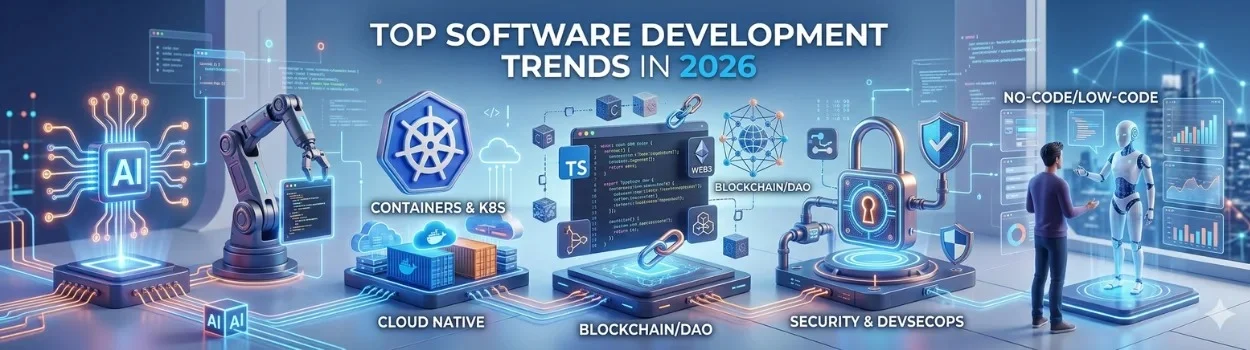
Technology is evolving at an unprecedented pace, and software development is at the center of this transformation. From AI-powered applications to cloud-native infrastructure, businesses in 2026 are rapidly adopting smarter, faster, and more scalable technologies to stay competitive.
Companies that fail to adapt to changing software trends risk slower operations, poor customer experiences, and reduced market relevance. On the other hand, organizations embracing innovation are improving automation, efficiency, security, and business growth.
Whether you are a startup founder, enterprise decision-maker, CTO, or entrepreneur, understanding the latest software development trends can help you make better technology investments for the future.
In this blog, we’ll explore the top software development trends in 2026, how they are reshaping industries, and what businesses should do to stay ahead.
Why Software Development Trends Matter in 2026
Software development is no longer just about building applications. It now plays a major role in digital transformation, automation, customer engagement, and operational efficiency.
Businesses across industries are investing heavily in modern software solutions because customer expectations are changing rapidly. Users now expect:
- Faster digital experiences
- Highly personalized applications
- Secure platforms
- Cross-device compatibility
- Real-time support and automation
At the same time, competition is increasing. Companies adopting emerging technologies earlier are gaining significant advantages in productivity and innovation.
Some key reasons why software trends matter in 2026 include:
- Increased demand for scalable digital products
- Rise of remote and cloud-based work environments
- AI-driven automation across industries
- Growing cybersecurity threats
- Need for faster software deployment cycles
Organizations that align with these trends can improve business performance while reducing operational complexity.

AI-Powered Software Development Will Dominate
Artificial Intelligence is no longer a futuristic concept. In 2026, AI has become one of the biggest drivers of software innovation.
Developers are increasingly using AI tools to automate coding, testing, debugging, and deployment processes. AI-powered software solutions are also helping businesses deliver better customer experiences through automation and personalization.
AI-Assisted Coding
Modern AI coding assistants can now:
- Generate code snippets
- Detect bugs automatically
- Recommend optimized code structures
- Speed up software development cycles
This significantly reduces manual work for developers and improves efficiency.
Generative AI Applications
Generative AI is transforming how software products are built. Businesses are integrating AI chatbots, content generators, recommendation engines, and intelligent assistants into their platforms.
Examples include:
- AI customer support systems
- Automated report generation
- AI-driven analytics dashboards
- Smart virtual assistants
3. AI-Powered Personalization
Generative AI is transforming how software products are built. Businesses are integrating AI chatbots, content generators, recommendation engines, and intelligent assistants into their platforms.
Examples include:
- AI customer support systems
- Automated report generation
- AI-driven analytics dashboards
- Smart virtual assistants
AI in Testing and Debugging
Software testing is becoming faster and more accurate with AI automation. AI tools can identify issues early in the development lifecycle, reducing downtime and improving software quality.
Benefits of AI-Powered Development
- Faster product launches
- Reduced development costs
- Improved user experiences
- Better decision-making through analytics
- Increased operational efficiency
Businesses investing in AI-driven software development are expected to gain major competitive advantages in 2026.
Low-Code and No-Code Development Expansion
Low-code and no-code platforms are becoming mainstream because businesses want faster and more cost-effective application development.
These platforms allow users to build applications with minimal coding knowledge using drag-and-drop interfaces and visual workflows.
Why Low-Code Development Is Growing
Traditional software development can be time-consuming and expensive. Low-code solutions help businesses:
- Develop apps quickly
- Reduce dependency on large development teams
- Improve workflow automation
- Accelerate digital transformation
Startups and SMEs especially benefit from low-code tools because they reduce initial technology costs.
Popular Use Cases
- CRM systems
- Workflow automation
- Internal business tools
- Customer service platforms
- Mobile applications
Limitations to Consider
Although low-code development offers speed and convenience, it may not always be ideal for highly customized enterprise-level applications requiring complex architecture.
Still, the market for low-code and no-code development is expected to expand significantly throughout 2026.
Cloud-Native Development Will Become Standard
Cloud-native development is no longer optional for modern businesses. It has become the standard approach for building scalable and flexible software applications.
Cloud-native applications are designed specifically for cloud environments using:
- Microservices
- Containers
- APIs
- Serverless computing
Rise of Microservices Architecture
Instead of building large monolithic systems, developers are now creating smaller independent services that can operate separately.
Benefits include:
- Faster updates
- Better scalability
- Improved flexibility
- Easier maintenance
Containerization with Kubernetes and Docker
Container technologies allow developers to package applications consistently across environments.
Kubernetes and Docker continue to dominate cloud-native infrastructure because they simplify deployment and scalability.
Serverless Computing Growth
Serverless architecture enables developers to run applications without managing physical servers.
Advantages include:
- Reduced infrastructure costs
- Automatic scaling
- Faster deployment
- Better resource optimization
Cloud-native development is helping businesses create highly reliable and scalable software ecosystems.
Cybersecurity-First Development Approach
Cybersecurity threats are increasing rapidly, making security a top priority in software development.
In 2026, businesses are shifting toward a cybersecurity-first approach where security is integrated into every stage of development rather than added later.
Secure Software Development Lifecycle (SSDLC)
Organizations are implementing SSDLC frameworks to ensure:
- Secure coding practices
- Regular vulnerability assessments
- Continuous monitoring
- Compliance management
Zero-Trust Security Architecture
Zero-trust models assume that no system or user should automatically be trusted.
This approach improves:
- Identity verification
- Access control
- Network security
- Data protection
API Security Importance
As APIs become essential for application connectivity, securing APIs has become critical to preventing cyberattacks.
Benefits of Cybersecurity-Focused Development
- Reduced security breaches
- Better customer trust
- Improved compliance
- Lower financial risks
- Stronger digital infrastructure
Businesses that prioritize cybersecurity will be more resilient against evolving cyber threats.
Rise of Blockchain-Based Applications
Blockchain technology is expanding beyond cryptocurrency and becoming increasingly important in enterprise software solutions.
Businesses are using blockchain to improve transparency, security, and transaction efficiency.
Decentralized Applications (dApps)
Decentralized applications operate on blockchain networks instead of centralized servers.
Benefits include:
- Enhanced security
- Greater transparency
- Reduced dependency on intermediaries
Smart Contracts
Smart contracts automate transactions and agreements without manual intervention.
Industries using smart contracts include:
- Finance
- Real estate
- Supply chain
- Insurance
Enterprise Blockchain Adoption
Large organizations are implementing blockchain solutions for:
- Secure record management
- Fraud prevention
- Digital identity verification
- Supply chain tracking
Blockchain-based software is expected to continue growing as businesses seek more secure and transparent systems.
Edge Computing and IoT Software Growth
The rise of connected devices is driving demand for edge computing and IoT software development.
Instead of processing data in distant cloud servers, edge computing processes information closer to the source device.
Benefits of Edge Computing
- Faster response times
- Reduced latency
- Improved real-time processing
- Better operational efficiency
IoT Expansion Across Industries
IoT applications are transforming:
- Manufacturing
- Healthcare
- Logistics
- Agriculture
- Smart cities
Examples include:
- Smart sensors
- Industrial automation systems
- Connected healthcare devices
- Predictive maintenance platforms
Edge AI Applications
Combining edge computing with AI allows devices to process data instantly without relying heavily on cloud infrastructure.
This is especially important for:
- Autonomous vehicles
- Smart factories
- Real-time surveillance systems
Edge computing and IoT are becoming essential technologies for modern digital ecosystems.
Progressive Web Apps (PWAs) Continue to Grow
Progressive Web Apps are gaining popularity because they combine the advantages of websites and mobile applications.
PWAs provide:
- Faster loading speeds
- Offline access
- Mobile responsiveness
- App-like experiences
Why Businesses Prefer PWAs
Compared to native apps, PWAs are:
- More affordable to develop
- Easier to maintain
- Faster to deploy
- Accessible across devices
Benefits for User Experience
- Improved engagement
- Lower bounce rates
- Better performance
- Reduced app installation barriers
Many businesses are adopting PWAs to improve mobile customer experiences while reducing development costs.
DevOps and Automation Will Evolve Further
DevOps continues to play a major role in modern software development by improving collaboration between development and operations teams.
Automation is becoming increasingly important for faster software delivery and continuous improvement.
CI/CD Pipeline Advancements
Continuous Integration and Continuous Deployment pipelines help businesses:
- Release updates faster
- Reduce manual errors
- Improve testing efficiency
- Enhance deployment reliability
Infrastructure as Code (IaC)
IaC allows infrastructure management through code instead of manual processes.
Benefits include:
- Faster provisioning
- Better consistency
- Easier scalability
- Reduced configuration errors
Rise of DevSecOps
Security is now being integrated directly into DevOps workflows.
This approach improves:
- Secure deployments
- Vulnerability management
- Compliance automation
Organizations adopting DevOps automation are achieving greater efficiency and faster product delivery cycles.
AR, VR, and Spatial Computing Applications
Augmented Reality and Virtual Reality technologies are becoming more advanced and accessible in 2026.
Businesses are increasingly using immersive technologies for customer engagement, training, and collaboration.
AR/VR in Training and Education
Companies are using virtual simulations for:
- Employee training
- Industrial safety education
- Medical simulations
Technical skill development
Retail and eCommerce Applications
AR is helping customers visualize products before purchasing.
Examples include:
- Virtual furniture placement
- Virtual try-on experiences
- Interactive product demonstrations
Spatial Computing Future
AR is helping customers visualize products before purchasing.
Examples include:
- Virtual furniture placement
- Virtual try-on experiences
- Interactive product demonstrations
Sustainable and Green Software Engineering
Sustainability is becoming a major focus in software development.
Businesses are now prioritizing energy-efficient technologies and environmentally responsible digital infrastructure.
Energy-Efficient Coding Practices
Developers are optimizing applications to:
- Reduce processing power
- Minimize server usage
- Improve application efficiency
Sustainable Cloud Infrastructure
Cloud providers are investing in:
- Renewable energy
- Efficient cooling systems
- Carbon reduction initiatives
Green Data Centers
Modern data centers are adopting eco-friendly technologies to reduce environmental impact.
Benefits of Green Software Engineering
- Lower operational costs
- Reduced carbon footprint
- Better resource optimization
- Improved brand reputation
Sustainable technology practices are expected to become standard across the software industry.
How Businesses Can Prepare for Software Development Trends in 2026
Adapting to new technologies requires strategic planning and long-term investment.
Businesses should focus on building flexible and scalable technology ecosystems that can evolve with changing market demands.
Invest in Scalable Technologies
Choose platforms and architectures that support future growth and integration.
Upskill Development Teams
Continuous learning is essential for keeping up with evolving technologies like AI, cloud computing, and cybersecurity.
Prioritize Cybersecurity
Implement proactive security strategies and secure development practices from the beginning.
Adopt Agile Methodologies
Agile development helps businesses respond quickly to changing customer needs and technology trends.
Partner with Experienced Software Development Companies
Final Thoughts
Software development in 2026 is being driven by innovation, automation, scalability, and security. Technologies like AI, cloud-native development, blockchain, IoT, DevOps, and immersive computing are transforming how businesses operate and deliver digital experiences.
Companies that embrace these trends early will gain significant advantages in efficiency, customer satisfaction, and long-term growth.
The future belongs to businesses that continuously innovate, adapt, and invest in modern software solutions.
Whether you are planning digital transformation, building new applications, or modernizing legacy systems, staying updated with software development trends is essential for long-term success.
Frequently Asked Questions
What are the biggest software development trends in 2026?
How is AI changing software development?
AI is automating coding, testing, debugging, analytics, and customer support, helping businesses improve efficiency and reduce development time.
Why is cloud-native development important?
Cloud-native development enables businesses to build scalable, flexible, and highly reliable applications optimized for modern cloud environments.
What industries benefit most from software innovation?
Industries such as healthcare, finance, manufacturing, retail, logistics, and education benefit greatly from modern software technologies.
How can businesses prepare for future software technologies?
Businesses should invest in scalable infrastructure, prioritize cybersecurity, train development teams, and adopt agile software development methodologies.
Ready to Build Future-Ready Software Solutions?
Modern businesses need scalable, secure, and innovative software to stay competitive in 2026 and beyond.
Whether you need AI-powered applications, cloud-native platforms, enterprise software, or digital transformation solutions, partnering with the right software development company can help accelerate growth and innovation.
Contact us today to discuss your software development goals and future-ready technology strategy.