Why Your Paid Ads Might Not Be Working
You’re spending money on Paid Ads, but the leads are inconsistent. Some days you get enquiries, other days… nothing. Your cost per lead is rising, and you’re unsure whether to double down or stop completely.
Many businesses reach a point where ad spend increases but results stay flat — that’s a clear sign something deeper is wrong.
Here’s the truth:
It’s not that ads don’t work — it’s that choosing the wrong platform (or strategy) is silently killing your ROI.
Even a good budget can fail if it’s not aligned with the right audience and intent stage.
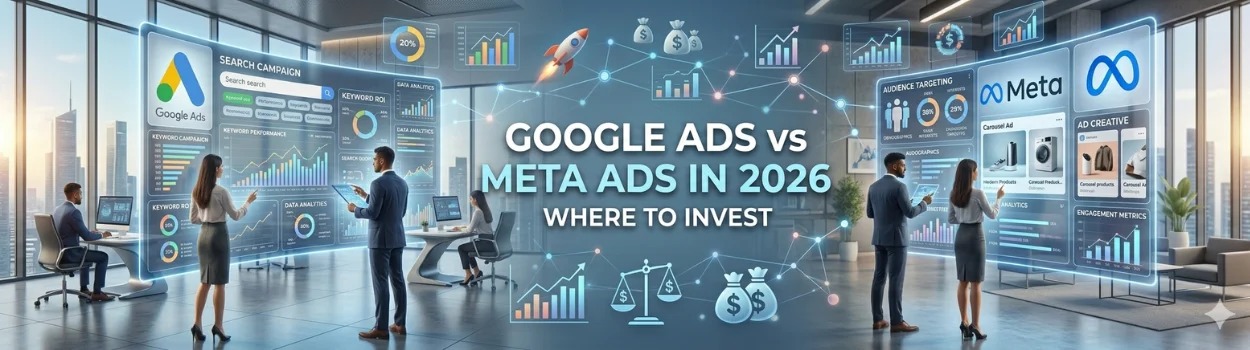
In 2026, the debate of Google Ads vs Meta Ads is more relevant than ever. Both platforms are powerful, but they serve completely different purposes.
Understanding this difference can save you lakhs in wasted spend and months of trial and error.
If you’re a business owner, startup founder, or entrepreneur, this guide will help you decide where to invest your budget for maximum returns.
More importantly, it will help you avoid common mistakes that most businesses make early on.
Google Ads vs Meta Ads: The Core Difference
Before choosing, you need to understand one key concept:
This single distinction will define your entire ad strategy and expected outcomes.
- Google Ads = Intent-based marketing
- Meta Ads = Attention-based marketing
These two approaches target users at completely different stages of the buying journey.
Google Ads
You show ads to people actively searching for your product/service.
This means you are capturing demand that already exists in the market.
Example:
Someone searches “SEO agency in Pune” → You appear → High chance of conversion.
This is why Google Ads often delivers faster ROI compared to other platforms.
Meta Ads (Facebook & Instagram Ads)
You show ads to people based on interests, behavior, and demographics.
Here, you are interrupting the user journey and introducing your brand.
Example:
User scrolling Instagram sees your ad → You create demand → Awareness + lead generation.
This makes Meta Ads ideal for businesses that want to scale visibility and build brand recall.
When to Choose Google Ads (High-Intent Leads)
If your goal is immediate leads and conversions, Google Ads is your best bet.
It works especially well when your audience already knows what they are looking for.
Best for:
- Service-based businesses (SEO, real estate, healthcare, consultants)
- Local businesses
- High-ticket services
- Urgent problem-solving products
These categories benefit the most because users usually search with a clear intent.
Why it works:
- People already have intent
- Faster conversions
- Higher quality leads
You’re not convincing the user — you’re simply showing up at the right time.
But here’s the catch:
- High competition = higher cost per click
- Requires strong landing pages
- Needs proper keyword strategy
Without optimization, costs can quickly rise and reduce profitability.
When to Choose Meta Ads (Demand Generation)
If your goal is brand awareness + scaling + nurturing, go for Meta Ads.
It’s the best platform to create demand where none existed before.
Best for:
- E-commerce brands
- New businesses/startups
- Personal brands
- Coaching & courses
These segments thrive on visibility, storytelling, and audience engagement.
Why it works:
- Massive audience reach
- Lower cost per impression
- Great for storytelling and creative marketing
It allows you to visually connect with your audience at scale.
But:
- Leads may be colder
- Requires strong creatives
- Needs follow-up funnel (retargeting)
Without nurturing, most leads won’t convert immediately.
Google Ads vs Meta Ads: Cost & ROI Comparison (2026)
Factor | Google Ads | Meta Ads |
Cost Per Click | Higher | Lower |
Lead Quality | High Intent | Medium Intent |
Conversion Time | Fast | Slower |
Best Use | Lead Generation | Awareness + Scaling |
ROI | High (if optimized) | High (with funnel) |
Bottom line:
- Want quick leads?→ Choose Google Ads
- Want brand growth + scale?→ Choose Meta Ads
The right choice depends on your business stage and goals.
In many cases, businesses start with one platform and expand once they see consistent results.
Balancing cost and quality is the key to long-term ROI.
The Real Problem: Why Most Businesses Fail in Paid Ads
Let’s be honest.
Most ad campaigns don’t fail overnight — they fail due to consistent small mistakes.
Most businesses don’t fail because of platform choice. They fail because of:
A lack of strategy and understanding of the customer journey is the main issue.
- No proper funnel
- Weak landing pages
- No retargeting strategy
- Poor ad creatives
- No data tracking
Each of these gaps reduces your chances of conversion significantly.
Running Google Ads or Meta Ads without strategy is like pouring water into a leaking bucket.
You might see some results, but most of your budget is wasted in the process.
The Smart Strategy in 2026 (What Actually Works)
Instead of choosing between Google Ads vs Meta Ads, smart businesses are doing this:
They focus on building a full-funnel approach rather than relying on a single platform.
Hybrid Strategy (Recommended)
- Meta Ads → Create Awareness
- Attract new audience
- Build brand visibility
This stage helps you reach people who didn’t even know your brand existed.- Retarget on Meta + Google Display
- Warm up audience
- Increase trust through repeated exposure
This is where most conversions start taking shape.- Google Ads → Capture Intent
- Convert high-intent users
- Close leads faster with search-based targeting
This ensures you don’t lose ready-to-buy customers.
This combination reduces cost and increases conversions.
It also creates a predictable and scalable lead generation system.
Practical Tips to Maximize Your Paid Ads ROI
- Target long-tail keywords (less competition)
- Optimize landing page speed & CTA
- Use call extensions for local leads These small optimizations can significantly improve conversion rates.
- Focus on search terms report to eliminate waste
- Continuously refine bidding strategy for better ROI
- Focus on video creatives (Reels work best)
- Use emotional hooks in first 3 seconds
- Always run retargeting ads Creative quality often matters more than targeting in Meta Ads.
- Test multiple audience segments regularly
- Use testimonials and social proof in creatives
- Track everything (conversion tracking is MUST)
- Test multiple creatives & audiences
- Optimize weekly (not monthly) Consistent optimization is what separates profitable campaigns from average ones.
- Use data to make decisions, not assumptions
- Scale only what is already working
- Need leads NOW? → Go with Google Ads
- Want to build brand & scale? → Go with Meta Ads
- Want consistent growth? → Use BOTH strategically There is no one-size-fits-all answer — only the right strategy for your stage.
- A clear funnel
- Data-driven ad strategy
- Conversion-focused landing pages These are the foundations of every successful campaign.
Final Thoughts
In 2026, winning in digital marketing is not about choosing between Google Ads vs Meta Ads — it’s about using them smartly together.
Integration is the real game changer, not platform selection.
The businesses that understand this are scaling fast.
They focus on systems, data, and continuous optimization.
The ones who don’t… keep burning budgets.
And often blame platforms instead of fixing strategy.
Which one are you going to be?