
In the hyper-accelerated digital economy of 2026, enterprise decision-makers are constantly bombarded with new technological acronyms. Currently, the most prominent debate dominating corporate boardrooms and marketing summits is the strategic battle of seo vs geo vs aeo. Global founders and marketing heads are urgently trying to determine where to allocate their budgets to secure market dominance.
At Niranjan Enterprises Digital Solutions (NEDS), we consult with industry leaders worldwide to architect predictable digital growth systems. We understand that navigating the complexities of seo vs geo vs aeo is not merely an academic exercise; it is about defining the foundational architecture of your customer acquisition pipeline.
Here is the definitive executive blueprint decoding the seo vs geo vs aeo debate, explaining what these frameworks actually mean, and detailing why a unified digital marketing strategy is the ultimate catalyst for improving online visibility, lead generation, brand authority, and ROI.
1. Decoding the Acronyms: The Evolution of Search
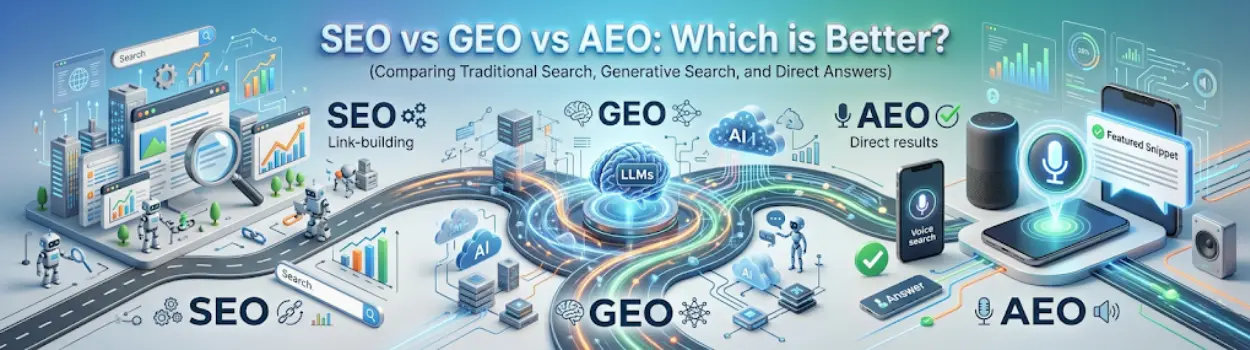
To understand the seo vs geo vs aeo landscape, we must first define the operational reality of each framework:
Traditional SEO: The foundation of search engine marketing. It involves technical website architecture, content relevance, local seo for regional dominance, and robust off page seo (like digital PR and backlinking). Traditional seo optimization focuses on ranking your web pages in the classic “10 blue links” to capture high-intent traffic.
GEO (Generative Engine Optimization): Search engines have evolved into AI-driven synthesizers. Generative engine optimization ensures that when an AI (like Google’s AI Overviews or Perplexity) reads the web to compile a custom summary for a user, your corporate data and brand are cited as the primary authoritative source.
AEO (Answer Engine Optimization): The era of zero-click searches and voice assistants. Answer engine optimization structures your website’s data so explicitly that search algorithms can extract instant, direct answers to complex user queries, featuring your brand without the user ever needing to click a link.
2. The Fallacy of the "seo vs geo vs aeo" Debate
When executives ask a top-tier seo agency which framework is better—seo vs geo vs aeo—they are fundamentally asking the wrong question. Viewing these concepts as competing silos is a critical strategic error that actively leaks pipeline revenue.
In a modern, results-driven seo digital marketing strategy, these three concepts are not competitors; they are layers of a unified customer acquisition ecosystem.
If you solely focus on traditional SEO, you will lose high-net-worth buyers who rely on AI summaries. If you solely focus on GEO, you lack the foundational website architecture to actually convert the traffic you generate. The true answer to the seo vs geo vs aeo debate is integration.

3. Architecting the Unified Customer Acquisition Engine
To achieve scalable business growth, visionary leaders must deploy a strategy that harmonizes these elements alongside paid advertising and rigorous performance marketing. Here is how this unified approach drives measurable outcomes:
Maximized Online Visibility & Brand Authority: By unifying your approach to seo vs geo vs aeo, your brand surrounds the buyer. You appear in the AI-generated summary (GEO), provide the instant featured snippet answer (AEO), and dominate the traditional organic search results (SEO). This omnipresence establishes unshakeable market authority.
Frictionless Lead Generation: Driving premium traffic is meaningless if your website creates buyer friction. By aligning your search strategy with deep website optimization, you ensure that the moment a prospect lands on your site, they are seamlessly routed through automated, high-converting consultation portals.
Predictable Performance Marketing ROI: At the executive level, every initiative must be mathematically justified. A cohesive strategy connects your organic search data directly to your paid advertising efforts. This ensures your performance marketing budget is spent strictly on high-yielding channels, drastically lowering your Customer Acquisition Cost (CAC).
Stop Debating and Start Integrating
In a digitized, borderless economy, digital inaction is a critical vulnerability. Becoming paralyzed by the seo vs geo vs aeo debate restricts your growth and leaves your market share exposed to highly agile competitors who have already integrated these systems.
The ultimate differentiator between market leaders who scale effortlessly and organizations paralyzed by high acquisition costs is the ability to unify these technologies into a single revenue engine.
At Niranjan Enterprises Digital Solutions (NEDS), we specialize in architecting these complex digital growth systems. We look beyond tactical debates to engineer the total entity dominance required to scale your global operations.
Are you ready to transcend the seo vs geo vs aeo confusion and build a mathematically profitable customer acquisition pipeline? Let’s schedule a strategic consultation to discuss how NEDS can deploy a custom blueprint to aggressively scale your enterprise.
Frequently Asked Questions
1. What is the core difference in the seo vs geo vs aeo debate?
SEO ranks your web pages, GEO ensures your brand is cited by AI-generated search summaries, and AEO structures your data to provide instant, zero-click answers to voice and smart-assistant queries.
2. Which framework provides the fastest ROI?
None of these organic frameworks operate overnight. For immediate pipeline velocity, you must pair your organic strategy with highly targeted paid advertising. However, integrating all three organic methods ensures the highest long-term ROI and lowest Cost Per Acquisition (CPA).
3. Does generative engine optimization replace the need for an seo agency?
No. GEO is an evolution of SEO, not a replacement. A premium seo agency will possess the technical expertise to optimize your underlying website architecture, which is a prerequisite for both GEO and traditional SEO success.
4. How does answer engine optimization impact B2B lead generation?
B2B procurement managers often ask highly specific, technical questions. By deploying AEO, your brand provides the immediate, authoritative answer directly on the search page, establishing immense trust before they even enter your sales funnel.
5. How does local seo fit into this new digital landscape?
Local seo remains the absolute foundation for businesses relying on regional dominance. Whether an AI is generating a summary or a traditional search algorithm is displaying map results, robust local optimization ensures your physical facilities are recommended first.
6. Is off page seo still relevant when optimizing for AI?
Absolutely. AI models (GEO) synthesize information based on consensus and authority. Strong off page seo—such as digital PR and authoritative brand mentions across the web—signals to AI that your enterprise is the undisputed industry leader.
7. How does website optimization support these search strategies?
You can win the seo vs geo vs aeo battle, but if your website is slow, non-responsive, or lacks clear conversion pathways, that traffic will bounce. Website optimization ensures the traffic you capture actually converts into paying clients.
8. How does NEDS handle the seo vs geo vs aeo strategy differently?
NEDS acts as your strategic executive growth partner. We do not treat these as isolated IT projects. We unify SEO, GEO, and AEO with your overarching performance marketing and revenue goals, creating a seamless, automated business growth engine.

