
What is AI Automation for Business Operations?
AI automation for business operations is the strategic deployment of artificial intelligence, machine learning, and predictive analytics to autonomously execute, manage, and optimize core corporate workflows.
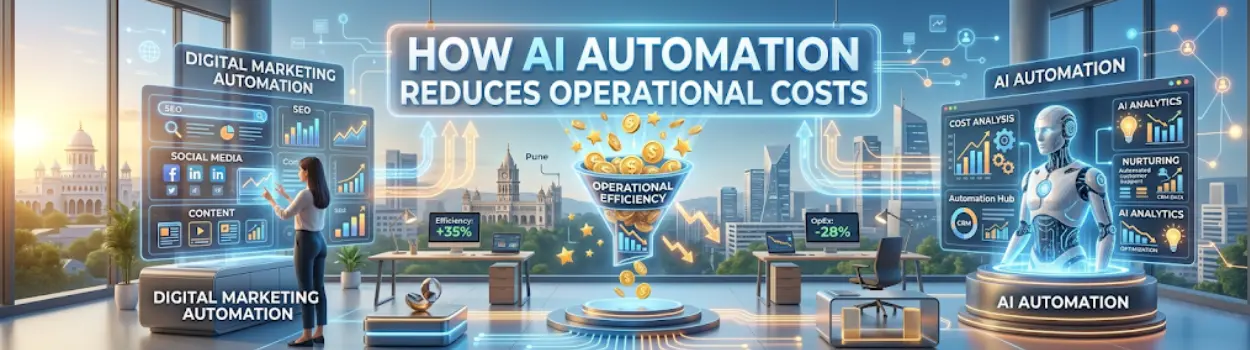
Unlike legacy software that relies on rigid, manual inputs, AI automation for business operations creates cognitive digital infrastructure. It allows your enterprise to autonomously analyze data, predict supply chain bottlenecks, personalize digital marketing campaigns, and qualify B2B leads in real-time. By leveraging AI automation for business operations, businesses transform static operational tools into proactive, intelligent assets that dramatically lower overhead costs, eliminate human error, and accelerate global customer acquisition.
The Before vs. After Scenario: Eliminating Operational Friction
To truly grasp the ROI of this technology, executives must visualize the structural shift. Here is what happens when an enterprise transitions from manual automation for business operations to cognitive AI automation:
| Business Function | Before: Manual / Legacy Systems | After: AI Automation for Business Operations | Financial Outcome |
| Lead Generation | Sales reps manually score and route inbound website leads. | ai workflow automation instantly scores intent and routes to calendars. | Drastic reduction in Customer Acquisition Cost (CAC). |
| Website Optimization | Static landing pages with generic “Contact Us” forms. | Dynamic pages with conversational AI qualifying traffic 24/7. | 2X increase in conversion rates from existing traffic. |
| Performance Marketing | Human analysts manually adjust ad bids weekly. | ai marketing automation adjusts bids in real-time based on CRM data. | Eliminates wasted ad spend and maximizes ROI. |
| Customer Support | Support tickets queue up, causing 48-hour delays. | AI resolves 80% of Tier-1 technical queries instantly. | Reduces headcount requirements while boosting brand authority. |
The Cost-Saving Model: How AI Automation Drives ROI
Implementing AI automation for business operations is not an IT expense; it is a revenue-protection strategy. The cost-saving model operates on three distinct pillars:
Overhead Reduction via AI Workflow Automation: By deploying ai workflow automation, enterprises eliminate the thousands of hours spent on repetitive data entry, inventory routing, and CRM updates. This allows you to scale your production and client onboarding without proportionately increasing your administrative payroll.
Marketing Efficiency via AI Marketing Automation: A results-driven digital marketing strategy requires mathematical precision. ai marketing automation connects your ad platforms directly to your sales data. It autonomously reallocates your paid advertising budget away from underperforming campaigns and channels it directly into high-yielding SEO and ad placements, protecting your marketing budget.
Revenue Capture via 24/7 Engagement: Human teams sleep; AI automation for business operations does not. By providing instant, frictionless responses to global buyers in different time zones, you capture revenue that would otherwise bounce to a competitor.

Industry Examples: AI Automation in Action
The application of AI automation for business operations adapts seamlessly to various enterprise models:
B2B Manufacturing: A heavy machinery manufacturer uses AI automation for business operations to sync their digital marketing lead generation directly with their ERP. When a procurement manager requests a quote online, the AI instantly checks global inventory and generates a customized pricing tier, shortening the sales cycle by weeks.
eCommerce & Retail: Global retailers utilize ai marketing automation to power their performance marketing. The AI predicts which users are most likely to purchase high-margin items and dynamically alters the website’s layout to highlight those specific products, driving massive online visibility and sales.
Healthcare & Clinics: Medical networks deploy AI automation to handle patient triage and appointment scheduling. The AI integrates with local SEO campaigns, allowing patients searching for immediate care to book instantly via an AI chatbot, streamlining clinic operations and maximizing patient acquisition.
Architect Your Intelligent Revenue Engine
In a digitized, borderless economy, relying on fragmented software and manual data processing is a critical vulnerability. Mastering AI automation for business operations is the ultimate differentiator between market leaders who scale effortlessly and organizations paralyzed by high operational friction.
By unifying elite technical SEO, precision paid media, and frictionless website optimization with the sheer processing power of AI automation for business operations, you create a self-sustaining ecosystem designed to capture, convert, and fulfill high-value contracts around the clock.
At Niranjan Enterprises Digital Solutions (NEDS), we specialize in architecting these complex digital growth systems. We speak the language of enterprise growth and know exactly how to integrate intelligent technology to engineer a predictable, highly profitable revenue engine for your business.
Are you ready to eliminate operational friction and scale your revenue? Let’s schedule a strategic consultation to discuss how NEDS can deploy AI automation for business operations to aggressively lower your costs and grow your global market share.
Frequently Asked Questions
1. What is the primary financial benefit of AI automation for business operations?
The primary benefit is the dramatic reduction in operational overhead and Customer Acquisition Cost (CAC). AI automation for business operations allows you to scale your revenue and handle massive increases in lead generation without needing to hire proportionately larger administrative or sales teams.
2. How does ai marketing automation improve my paid advertising ROI?
ai marketing automation analyzes millions of data points in real-time to autonomously adjust your ad bids. It ensures your budget is spent strictly on users who exhibit high commercial intent, eliminating wasted clicks and maximizing performance marketing ROI.
3. Does implementing AI automation for business operations require replacing all our current software?
Not necessarily. Top-tier agencies use advanced APIs to integrate AI automation for business operations into your existing CRM, ERP, and marketing platforms, creating a unified, intelligent layer over your current tech stack.
4. How does ai workflow automation improve B2B customer acquisition?
B2B buyers expect speed. ai workflow automation eliminates the friction between marketing and sales. When a lead is captured, the AI instantly scores it, enriches the data, and routes it to the correct executive, accelerating the sales cycle and building immense brand authority.
5. Is AI automation for business operations secure for enterprise data?
Yes. When architected correctly by a strategic partner, AI automation for business operations utilizes advanced, encrypted cloud environments. It actively monitors for data anomalies, making it highly secure for proprietary corporate information.
6. Can automation for business operations help with our SEO and online visibility?
Indirectly, yes. AI automation for business operations powers dynamic website optimization and intelligent chatbots. This creates a frictionless user experience, keeping visitors engaged longer. Search engines reward this high engagement with better organic SEO rankings.
7. How long does it take to see a reduction in costs after deploying AI automation?
Because tools like ai marketing automation and conversational chatbots deploy relatively quickly, businesses typically see a noticeable improvement in conversion rates and a drop in wasted ad spend within the first 30 to 60 days.
8. How does NEDS execute AI automation for business operations differently?
NEDS acts as a strategic executive partner. We do not just sell software; we align your AI automation for business operations architecture directly with your overarching digital marketing, SEO, and revenue generation goals to build a unified business growth engine.

